OCTI's Thematic Bulletin reveals opportunities to strengthen Science, Technology & Innovation in Mato Grosso.
12 of November, 2026
Share:
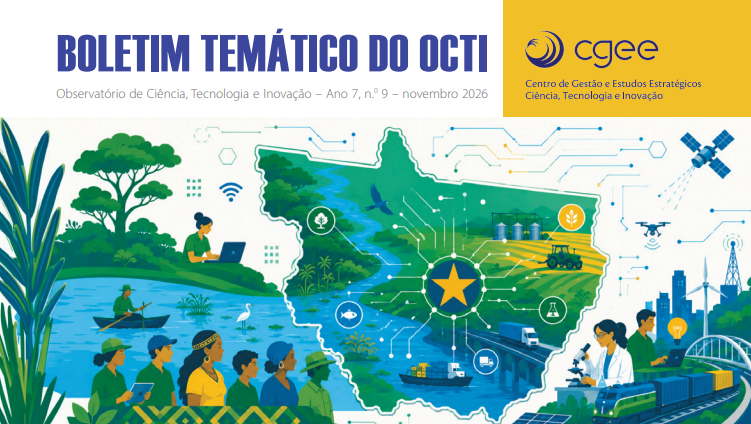
The CGEE publication compiles data on researcher training, scientific skills, and regional vocations to support the technological and sustainable development of the state.
Mato Grosso boasts significant scientific capabilities, environmental diversity, and a nationally prominent economy. But how can this potential be transformed into innovation, opportunities, and development for its different regions? This is one of the questions addressed in the new edition of the Mato Grosso Thematic Bulletin, a publication of the Observatory of Science, Technology and Innovation (Octi), of the Center for Management and Strategic Studies (CGEE).
This edition presents an overview of the state's science, technology, and innovation (ST&I) capabilities, relating socioeconomic indicators, researcher training, scientific skills, and territorial characteristics. The bulletin also identifies challenges and opportunities to strengthen the State ST&I System and expand the application of scientific knowledge in productive activities and public policies.
The report presents a territorial analysis that considers the five intermediate geographic regions of the state: Cuiabá, Sinop, Rondonópolis, Cáceres, and Barra do Garças. The analysis relates productive vocations, existing capacities, and regional demands, highlighting that innovation opportunities take on distinct characteristics in each territory.
This publication brings together national indicators, territorial analyses, and contributions gathered during workshops held in the process of developing the Mato Grosso State Plan for Science, Technology and Innovation (PCTI-MT). Developed by CGEE based on a request from Seciteci-MT and Fapemat, the Plan shares part of this evidence base with the bulletin, which presents its own interpretation of the capabilities, challenges, and opportunities for science, technology, and innovation in the state.
By integrating different sources of information, Octi reinforces its role in transforming data into strategic intelligence to support decision-making. More than just identifying the scientific potential of Mato Grosso, the thematic bulletin provides resources to bring knowledge, innovation, and regional development closer together.
Scientific training is advancing, but still faces challenges.
One of the highlights of the report is the expansion of training and professional placement of masters and doctoral degree holders in Mato Grosso. In 2023, 841 masters and 207 doctoral degrees were awarded in the state, corresponding to approximately 22.3 and 5.5 graduates per 100,000 inhabitants, respectively. Despite the expansion, these rates remain below those observed in the Central-West Region and in Brazil as a whole. The survey also shows the expansion of formal employment for these professionals. Between 2009 and 2023, the number of employed masters degree holders increased from 2,416 to 8,959, while the number of doctoral degree holders increased from 989 to 4,037.
Another relevant finding is the significant participation of public administration in the formal employment of these professionals, an aspect that contributes to understanding the relationships between scientific training, research institutions, and productive activities in Mato Grosso. In 2023, only 15.2% of master's degree holders and 9.1% of doctoral degree holders employed in the state were linked to private business entities.
To better understand the scientific competencies of Mato Grosso, OCTI analyzed the bibliographic production of 1,478 PhDs awarded by institutions in the state between 1997 and 2025. The investigation identified seven thematic fields of scientific competence, highlighting education, health, agricultural production, environmental sustainability, and territorial issues. These fields reveal scientific competencies that can contribute to understanding challenges and opportunities related to the economic, social, and environmental development of Mato Grosso.
Opportunities for innovation lie within the territories.
The economic and environmental diversity of Mato Grosso also occupies a central place in the publication. With more than 903,000 km² and three important Brazilian biomes (Amazon, Cerrado and Pantanal), the state presents opportunities to develop solutions in sustainable agriculture, bioeconomy, biotechnology, renewable energies, environmental technologies and public services.
The survey also identifies six major challenges for strengthening science, technology, and innovation (ST&I): funding, governance and institutional coordination, training and integration of qualified professionals, scientific and digital infrastructure, economic diversification, and sustainable development in the face of climate change.
The publication emphasizes that overcoming these challenges depends not only on increasing investments, but also on coordination between institutions, the decentralization of scientific capabilities, and the alignment of research with the economic, social, and environmental needs of the population.
From data production to public policy planning.
The bulletin compiles and expands upon some of the analyses from the PCTI-MT, demonstrating how scientific information, indicators, and expert contributions can support the identification of priorities and the formulation of public policies aligned with the characteristics of the territory.
This edition also features perspectives from experts linked to public administration, the productive sector, and academia, who delve into issues related to the governance of the state system, business innovation, and climate sustainability and resilience.
Related news
CGEE apresenta indicadores de especialização científica do Brasil durante a ExpoT&C/SBPC
30 of July, 2026Palestra realizada na ExpoT&C, durante a 78ª Reunião Anual da SBPC, apresentou novos indicadores de especialização científica desenvolvidos pelo Octi.
CGEE publica Informe OCTI sobre especialização científica e futuro da CT&I brasileira
23 of July, 2026Publicação reúne indicadores sobre a produção científica brasileira e permite identificar áreas de destaque, lacunas e oportunidades de cooperação internacional.
The launch of a technical note on digital sovereignty will take place in a webinar promoted by CGEE.
28 of May, 2026The Digital Technologies Observatory (OTD) initiative at the Center seeks to promote a qualified dialogue between experts, public managers, and the community interested in digital policies and science, technology, and innovation.