Brazil has the potential to advance in the critical minerals supply chain.
16 of October, 2026
Share:
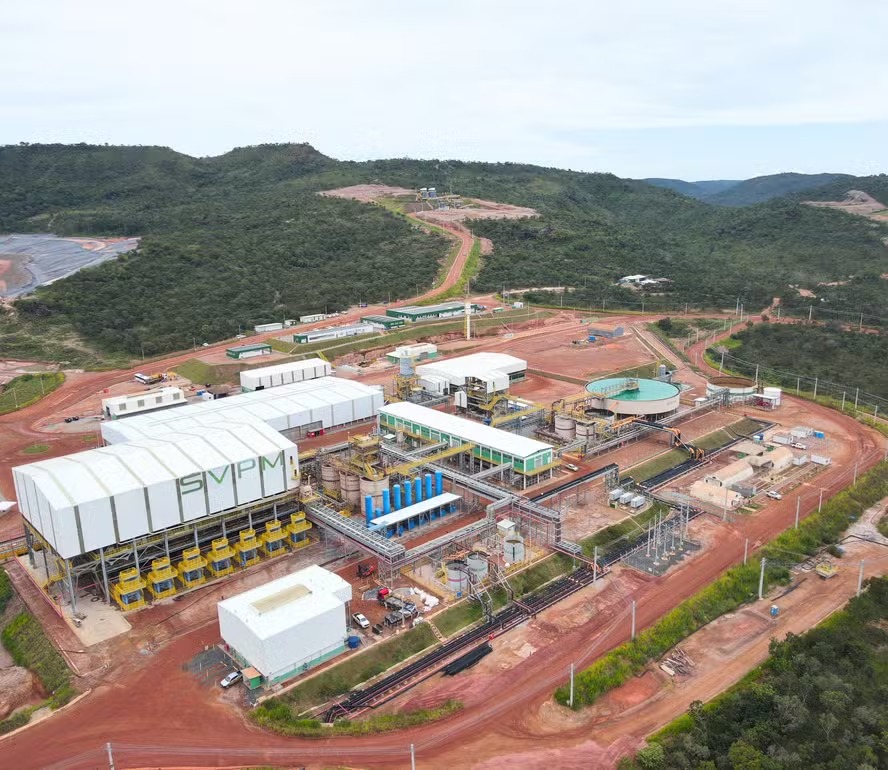
Photo: Press release/Serra Verde
In an article published in O Globo, the CEO of CGEE, Anderson Gomes, highlights opportunities and challenges for adding value to national production.
Usina de mineradora Serra Verde, no norte de Golás. Empresa, controladas por fundos americanos, é a única que produz terras-raras no Brasil.
The ten main projects involving critical minerals in Brazil already represent investments of R$ 39.4 billion, according to a survey conducted with the Ministry of Mines and Energy (MME) and companies in the sector. The list includes large projects, in different stages, from implementation to production, and also various types of minerals. The expectation is that the new framework for the segment, approved last month, will attract even more investment.
- Incentives: Energy transition depends on urban infrastructure and greater access to electricity for the population.
- EU proposal: Rule changes could affect carbon credit exports.
Despite the optimism, access to financing and skilled labor are cited by business leaders and experts as bottlenecks for the development of this industry.
The law establishing the policy for critical minerals defines them as those necessary for the national economy and whose availability is insufficient or unstable due to deficient domestic production or high dependence on imports.
When reserves of these minerals are concentrated in single suppliers or in areas of geopolitical risk, they are also considered critical, especially if their scarcity poses a risk to the energy transition, food security, and national or technological sovereignty.
BNDES maps projects
Thus, this category includes everything from inputs used in the manufacture of fertilizers to so-called rare earth elements, used in the production of electronic equipment, electric car batteries, wind turbine blades, and defense equipment.
One of the sector's most heavily invested projects currently is Autazes, by Potássio do Brasil. With resources of R$ 12.4 billion and a projected production of 2.4 million tons per year of potassium chloride, used in the fertilizer industry, the venture is in the mining permit application phase at the National Mining Agency (ANM). Despite being an agricultural powerhouse, Brazil is an importer of raw materials for fertilizer.
- Projects in Ceará: Data centers are advancing in the Northeast, but they bring challenges to the region.
Also among the main ventures is the Caldeira project, developed by Meteoric Resources in the municipality of Caldas (MG). The objective is to produce mixed rare-earth carbonate. The project was recently acquired by Lynas Rare Earths, which bought 100% of Meteoric for approximately R$ 3.5 billion.
This was the first operation following the approval of the new legal framework. Lynas is the only commercial producer of separated light and heavy rare earth oxides outside of China. In Brazil, the company is evaluating investment in refining.
"We intend to evaluate various financing options to support the future development of the Caldeira project, including strategic financing in the country as available, project financing, Lynas' current cash flow, and cash generated by existing operations," the company said in a statement.
-
Energy Transition: Innovation and planning, the keys to Chinese dominance in clean energy.
The search for financing is one of the barriers preventing projects from moving towards the industrialization of the critical minerals supply chain. BNDES has been working to address this issue. In addition to traditional credit lines, the bank maintains an open Private Equity Fund (PEF) earmarked for projects in the critical minerals sector with Vale, which is beginning to make its first investments.
The institution also selected 56 business plans in a public call with the Financing Agency for Studies and Projects (Finep). Today, negotiations are more advanced with 12 companies.
"We will have more opportunities to obtain credit in the country. Today, all financing is external. That's the big bottleneck. The guarantee fund is an innovation. It tends to boost the sector" - João Gustavo Morais, CEO of Ore Minerals
"We don't just want to export minerals, but to generate added value. BNDES has this role. This is totally linked to the New Industry Brazil (the federal government's industrial policy). One of the priorities is the energy transition," stated José Luis Gordon, Director of Productive Development, Innovation and Foreign Trade at BNDES.
Petrobras' interest
The bank is also in talks with Petrobras. In addition to maintaining research lines, the state-owned company is seeking investment opportunities. It is attentive to potential synergies with the battery supply chain, a segment in which minerals such as lithium play a strategic role. The oil company has registered its own projects and those in partnership in the Energy Storage Capacity Reserve Auction, scheduled for December.
All the funded projects are for mineral processing. None are solely mining. Some are further along, others are in the early stages, but all involve some type of beneficiation – said Gordon.
According to the executive, smaller companies are on the bank's radar and deserve special attention. This is the case with Viridis, a rare-earth mining company, which had R$ 77.5 million in financing approved for its Rare-Earth Research and Processing Center, inaugurated in May of this year. There, it will produce mixed rare-earth carbonate on a pilot scale.
"The only country that has the capacity to reach the same level of supply chain, in some applications, as China does, is Brazil. If it starts selling reserves, it will lose money and miss the boat" - Anderson Gomes, president of the Center for Management and Strategic Studies (CGEE).
Viridis owns the Colossus project in Poços de Caldas (MG), a R$ 2.3 billion investment currently under implementation. In the coming weeks, an advance sale (offtake) contract will be signed with Solvay, which will acquire approximately 70% of the production and plans to process part of the material at its industrial unit in La Rochelle, France.
"We'll have 30% to explore opportunities. There's no consumption of rare earth carbonates in Brazil, but we're bringing in a separation of a rare earth element, which is lanthanum. It will be extracted here, and we intend to supply the Brazilian market," said Klaus Petersen, CEO of Viridis.
The mineral can be used in batteries, specialty glasses, and in processes within the petroleum industry, among other applications. Viridis is awaiting its installation license. The intention is to begin production in the second half of 2028.
The new regulatory framework provides financial benefits for investors. It establishes tax credits, guarantees for obtaining loans, and incentives for industrial processing in Brazil. The Mineral Activity Guarantee Fund (FGAM) may receive up to R$ 2 billion in contributions from the Federal Government to reduce the perceived risk for banks and financiers.
According to João Gustavo Morais, CEO of Ore Minerals, investors haven't yet had time to benefit from the new incentives because the regulatory framework still needs to be finalized. However, he believes the enactment of the law was enough to boost business optimism.
— We will have more opportunities to obtain these loans in the country. Today, all financing is external. That is the major bottleneck. The guarantee fund is an innovation. It tends to boost the sector.
Skilled labor
Ore owns the Rio Negro project in Paraná, focused on rare earth elements. It plans to invest approximately US$100 million over six years, divided into three phases. Pilot production is scheduled for 2028.
The biggest challenge for projects involving critical minerals, according to the president of the Brazilian Mining Institute (Ibram), Pablo Cesário, is finding a financial solution. He cites the example of Canada and Australia, which use a tax mechanism to mitigate the impact of long-term investment.
Cesário argues that, as is the case in both countries, research expenditure should also be considered eligible for tax purposes in Brazil, allowing the amount to be deducted from tax payments.
In addition to funding, the president of the Center for Management and Strategic Studies (CGEE), Anderson Gomes, points to the lack of specialized personnel in critical minerals as a major bottleneck to be resolved in the sector.
"The big step now is the regulation of the law. The only country that has the capacity to reach the supply chain, in some applications, like China, is Brazil. And it has this because of its reserves. If it starts selling reserves, it will lose money and miss the boat," emphasized Gomes.
The new national policy for the sector also covers strategic minerals, those with significant reserves that are essential for generating a trade surplus, for technological and regional development, such as iron ore. If the projects for these minerals in the MME's portfolio are considered, the investments are even greater.
By Fernanda Nunes - O Globo (RJ).
This article was originally published in O Globo.