CGEE opens 25th anniversary celebrations with a debate on the role of social organizations in strengthening public policies.
19 of May, 2026
Share:
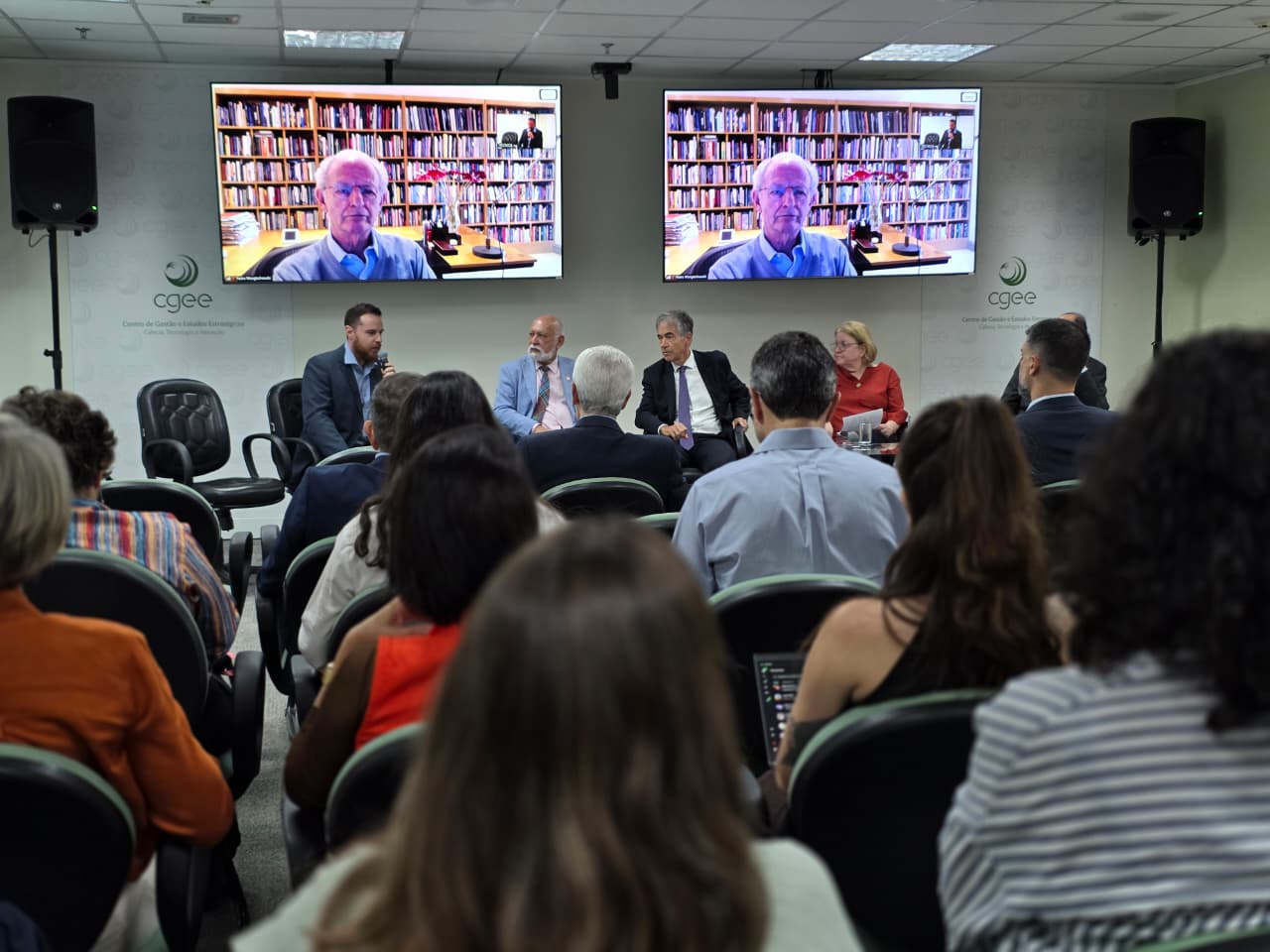
Seminar brings together government representatives, experts and leaders of NGOs to discuss the trajectory, challenges and improvement of the model in the National System of Science, Technology and Innovation.
The Center for Management and Strategic Studies (CGEE) opened today (19), at its headquarters in Brasília (DF), the commemorative program for its 25th anniversary with the seminar “The Model of Social Organizations for the Promotion of Public Policies: Current Situation, Lessons Learned and Paths for Improvement”. The meeting brings together representatives of the federal government, leaders of social organizations, specialists and former managers to discuss the advances, challenges and perspectives of the model in the National System of Science, Technology and Innovation (SNCTI).
At the opening of the event, the CEO of CGEE, Anderson Gomes, highlighted the Center's trajectory in producing strategic studies and supporting the formulation of public policies for the country. According to him, CGEE has consolidated itself, over 25 years, as an institution focused on the strategic intelligence of the Brazilian State, acting both on structural demands and on priority agendas.
Anderson Gomes stated that the current moment demands that the Center advance to a new institutional level, expanding its role beyond the development of studies and indicators. According to him, the CGEE should also contribute to the implementation of the solutions and policies formulated.
Representing the Ministry of Management and Innovation in Public Services (MGI), the general coordinator, Eduardo Monteiro Pastore, emphasized that the seminar is taking place at an important moment for the debate on the model of social organizations in the country. He recalled the challenges faced since the creation of the legislation for Social Organizations, including legal questions, budgetary difficulties, and discussions about governance.
For Pastore, the current debate surrounding social organizations should be seen as an opportunity for institutional maturation. "Social organizations should serve as a beacon for Brazil to learn how to think about a way to have shared governance," he stated. According to him, this model represents "the most democratic way" to provide public services.
Participating remotely, Pedro Wongtschowski, a member of the Board of Directors of Embrapii and coordinator of the Business Mobilization for Innovation (MEI), highlighted that social organizations represent a partnership between the State and the private sector aimed at implementing strategic public policies, especially in the area of science and technology. He believes that misunderstandings about the model still exist, often confusing it with privatization processes.
Wongtschowski argued that Social Organizations (OSs) function as an extension of the State's operational capacity, offering greater administrative flexibility without neglecting the commitment to public goals defined in management contracts. "The OS is a more efficient, faster, more agile, and more effective instrument for the State to meet certain objectives," he stated.
Connie Macmannus, Director of Strategic Projects and Institutional Relations at CGEE, highlighted that completing 25 years within the context of Brazilian public administration represents a demonstration of institutional resilience. According to her, the social organization model was conceived precisely to create more flexible institutional arrangements capable of responding to the contemporary challenges of science, technology, and innovation.
The leader highlighted that the debate promoted by the seminar seeks to overcome extreme views about social organizations and to build a critical analysis of their results, limitations, and possibilities for improvement. “Innovation doesn't happen within a bureaucratic calendar. We can't wait for the process to go up to a higher level to receive a stamp of approval,” she stated.
In turn, the CEO of the Brazilian Industrial Research and Innovation Company (Embrapii), Álvaro Prata, stated that social organizations play a strategic role in strengthening the National System of Science, Technology and Innovation. He highlighted the importance of the seminar as a space to discuss the advances, difficulties, and paths to institutional strengthening of the model.
Prata also highlighted the importance of social organizations for the country. "I am absolutely convinced that [the NGOs] are a very important part of our National System of Science, Technology and Innovation," he stated.
Concluding the opening session, the executive secretary of the Ministry of Science, Technology and Innovation (MCTI), Luis Fernandes, recalled the historical context of the creation of CGEE and social organizations in the early 2000s. According to him, the model faced strong political and institutional resistance in its first years, including questions about its constitutionality.
Luis Fernandes stated that the consolidation of social organizations occurred based on concrete results for the country. Among the examples cited, he highlighted CGEE's contribution to the formulation of the Biosafety Law, the Innovation Law, the 5th National Conference on Science, Technology and Innovation, and the Brazilian Artificial Intelligence Plan.
The executive secretary also argued that social organizations constitute one of the most effective instruments for the execution of strategic projects of public interest in the area of science, technology and innovation. "For strategic projects of public interest, the form of social organizations proves to be the most effective way to serve the public interest," he stated.
The seminar is part of the commemorative agenda for CGEE's 25th anniversary, which will continue throughout 2026 with thematic events, institutional memory initiatives, and debates focused on the future of science, technology, innovation, and strategic public policies for national development.
Schedule
Following the opening session, the seminar continues with the panel “Origin and rationality of the model”, which will include the participation of Professor Carlos Américo Pacheco from the University of São Paulo (USP); Professor Humberto Martins from the Dom Cabral Foundation; and Professor and legal consultant for the Attorney General's Office (AGU), Valéria Salgado.
Next, the panel “Implementation and Legal Debates” will take place, with the participation of Vanessa Constantini, auditor from the Comptroller General of the Union (CGU); Fábio Barreto, director of the Ministry of Science, Technology and Innovation (MCTI); and moderated by Nelson Simões, representative of the Forum of Social Organizations.
The third panel, "Current Status of the Model for Science, Technology & Innovation," will feature the participation of the CEO of the Brazilian Industrial Research and Innovation Company (Embrapii), Álvaro Prata; researcher João Fernando; and legal consultant from the Attorney General's Office (AGU), Leila Moraes; moderated by the former president of CGEE and representative of the Financing Agency for Studies and Projects (Finep), Mariano Laplane.
The program will conclude with the panel “Paths to Improvement,” which will feature the participation of the CEO of CGEE, Anderson Gomes; the researcher from the Santos Dumont Institute (ISD), Reginaldo Freitas; and the representative from the Ministry of Management and Innovation in Public Services (MGI), Sheila Ribeiro; moderated by the former CEO of CGEE and professor at the Pontifical Catholic University of Rio de Janeiro (PUC-Rio), Fernando Rizzo.
The broadcast is available at: https://www.youtube.com/live/6DP6qdun_6U?si=YlPlq_fTThYYZdMh
Related news
CGEE integra Comissão Organizadora da 1ª Conferência Nacional da Engenharia
2 of October, 2026Iniciativa reúne governo, instituições de ensino e pesquisa e representantes do setor produtivo para discutir os desafios da engenharia e sua contribuição para o desenvolvimento sustentável e tecnológico do país
CGEE supports MIT ANPEI Brazil Summit 2026 on innovation and competitiveness.
22 of September, 2026The event, which will take place on October 8th in São Paulo, will bring together leaders, experts, companies, and institutions to discuss strategies for cooperation, open innovation, and resilience in the face of the transformations of the global landscape.
CGEE holds a technical-scientific event about its history and contributions to science, technology, and innovation.
3 of September, 2026A special session, on September 21st, will bring together leaders from the science, technology, and innovation ecosystem to reflect on the role of science in formulating public policies and making strategic decisions for the country.