CGEE presents its trajectory in building a forward-looking perspective in Science, Technology & Innovation at a workshop by ECLAC.
2 of June, 2026
Share:
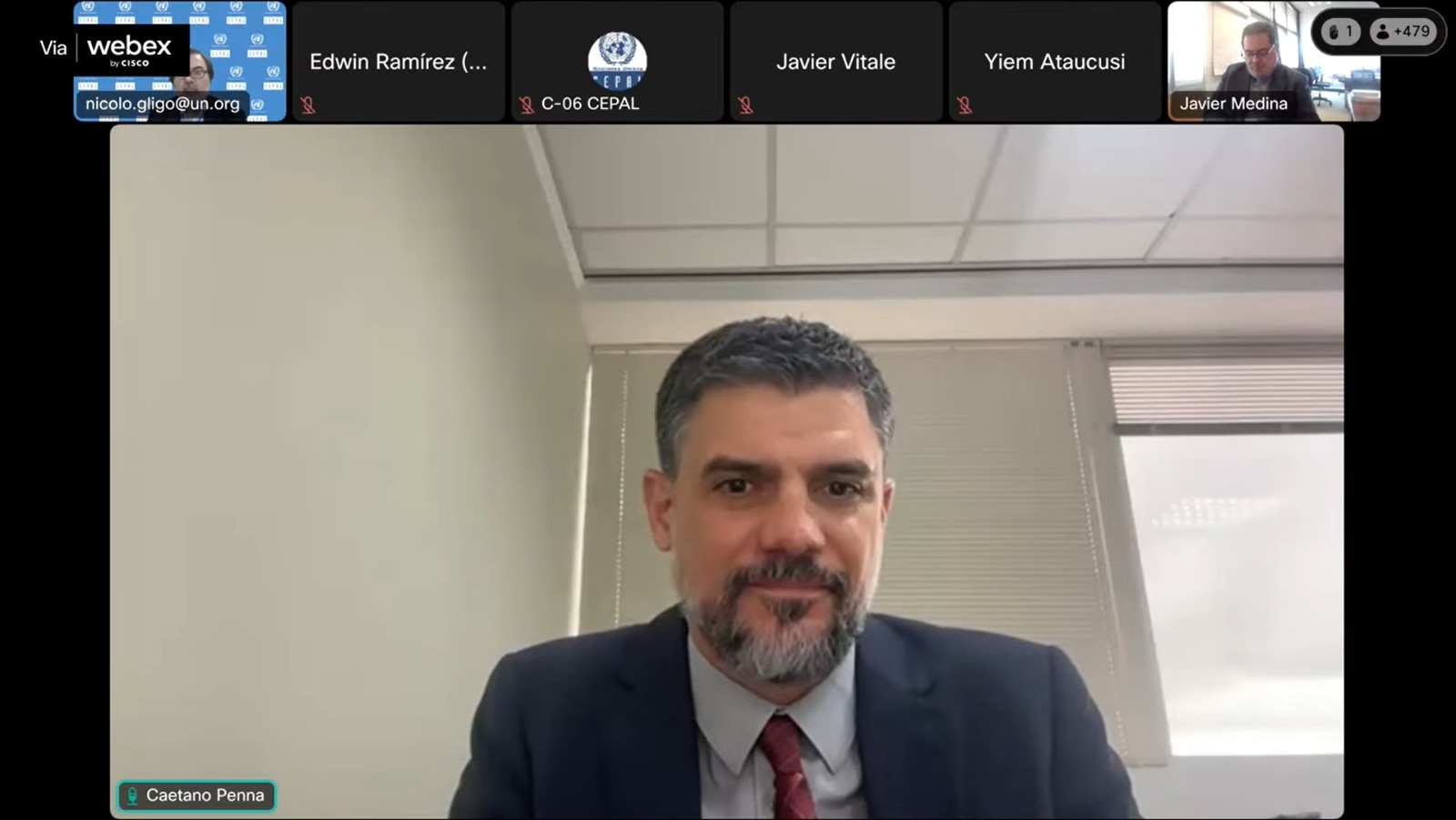
The Center's Director, Caetano Penna, highlighted the evolution of the institution's capabilities to monitor trends and anticipate scenarios in Science, Technology & Innovation.
The Director of Strategic Projects and International Relations at CGEE, Caetano Penna, participated yesterday (June 1st) in the Seminar “Training Workshop on Foresight and Monitoring for Science, Technology and Innovation Policies”, promoted by the Economic Commission for Latin America and the Caribbean (ECLAC). In his presentation, entitled “Thinking about the future in S&T&I: the trajectory of CGEE”, the director shared an analysis of the evolution of the institution's foresight capabilities since its creation. The event takes place from June 1st to 4th, from 12 pm to 2 pm (Brasilia time), with transmission via ECLAC's YouTube channel.
During the lecture, Penna presented a reflection on the role of CGEE as a permanent system for foresight, monitoring, and anticipation in science, technology, and innovation (ST&I). According to him, the institution brings together characteristics that are uncommon in organizations in the global south, such as a specialized technical team, its own information platforms, networks of experts, mechanisms for articulation, and connection with decision-making cycles.
As part of the presentation, the director shared an exercise developed specifically for the workshop. The analysis compiled annual reports, management contracts, institutional documents, and articles published by the Strategic Partnerships Journal, allowing the identification of 62 distinct future-oriented initiatives undertaken by CGEE since its creation.
In the survey, Penna proposed an interpretation of the Center's institutional trajectory in different phases. The first dates back to the period before the creation of CGEE, when strategic scenario studies were conducted by the then Center for Strategic Studies, linked to the Secretariat of Strategic Affairs of the Presidency of the Republic. The second corresponds to the consolidation of prospective methodologies, with emphasis on Delphi exercises and sectoral studies. Subsequently, the institution moved into a phase marked by the development of its own approaches to technological foresight, roadmapping, and scenario building, expanding its activities with different institutions of the federal government.
According to the analysis presented, from 2015 onwards there was a strengthening of observatories and monitoring systems, focusing on indicators, science, technology and innovation metrics, and trend tracking. Fundamental to understanding the evolution of the National System of Science, Technology and Innovation, these initiatives began to concentrate greater attention on surveillance and data monitoring, to the detriment of explicit initiatives for technological prospecting and future studies. However, foresight and anticipation methodologies were implicitly and transversally mobilized across the CGEE's project portfolio.
Penna highlighted that, despite this, CGEE is currently experiencing a movement of explicit resumption of future studies. Among the examples cited are the work related to the National Strategy for Science, Technology and Innovation, the Brazilian Artificial Intelligence Plan, studies on critical minerals and rare earths, the institution's capacity building in the area of futures literacy, quantum technologies, the event International workshop on technology foresight: ST&I opportunities for cooperation among BRICS, and initiatives focused on sustainability, energy transition and digital transformation.
Penna highlighted, however, that CGEE is currently experiencing a movement of explicit resumption of future studies. Among the examples cited are works related to the National Strategy for Science, Technology and Innovation, the Brazilian Artificial Intelligence Plan, studies on critical minerals and rare earths, quantum technologies, and initiatives focused on sustainability, energy transition, and digital transformation.
The director also presented the institution's current capability structure, organized into three main blocks: methodological, systemic, and thematic. The first brings together expertise in foresight, future studies, technological roadmapping, and data analysis. The second is related to understanding the National System of Science, Technology, and Innovation. In turn, the third focuses on strategic themes such as sustainability, climate change, artificial intelligence, connectivity, and critical and emerging technologies.
In concluding his presentation, Penna emphasized that the existence of consolidated institutional capabilities does not, in itself, guarantee the production of strategic anticipation. According to him, these capabilities need to be continuously activated by long-term visions and demands capable of mobilizing the knowledge accumulated by the organization. "Having the system is a necessary condition, but it is fundamental to orient it forward, to anticipate the future in addition to monitoring the present," he concluded.
Related news
CGEE integra Comissão Organizadora da 1ª Conferência Nacional da Engenharia
2 of October, 2026Iniciativa reúne governo, instituições de ensino e pesquisa e representantes do setor produtivo para discutir os desafios da engenharia e sua contribuição para o desenvolvimento sustentável e tecnológico do país
CGEE supports MIT ANPEI Brazil Summit 2026 on innovation and competitiveness.
22 of September, 2026The event, which will take place on October 8th in São Paulo, will bring together leaders, experts, companies, and institutions to discuss strategies for cooperation, open innovation, and resilience in the face of the transformations of the global landscape.
CGEE holds a technical-scientific event about its history and contributions to science, technology, and innovation.
3 of September, 2026A special session, on September 21st, will bring together leaders from the science, technology, and innovation ecosystem to reflect on the role of science in formulating public policies and making strategic decisions for the country.