CGEE releases technical note and presents ways to strengthen digital sovereignty in Brazil.
3 of June, 2026
Share:
The webinar hosted by CGEE brought together government, academia, and experts to discuss the development of national capabilities in digital technologies.
O link para download da nota técnica está disponível na matéria abaixo!
Digital sovereignty is an essential dimension of national sovereignty and requires an integrated long-term strategy based on science, technology and innovation. This analysis was shared by representatives of the federal government, researchers and experts during a webinar held yesterday (02) by the Digital Technologies Observatory (OTD), an initiative of the Center for Management and Strategic Studies (CGEE). The initiative is partnered with the Ministry of Science, Technology and Innovation (MCTI).
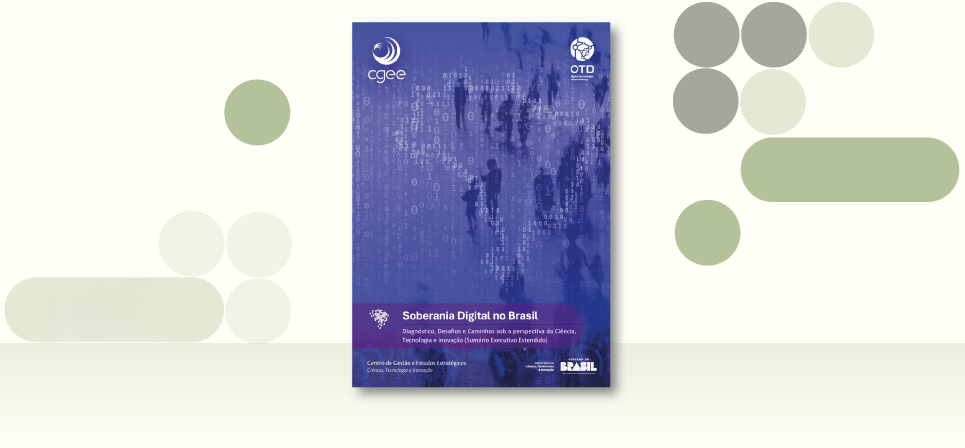
The event marked the launch of the technical note “ Digital Sovereignty: foundations, diagnosis and recommendations for Brazil ”, prepared by Professor Luca Belli of the Getulio Vargas Foundation (FGV) and consultant to CGEE. The study presents an overview of national capabilities, identifies structural challenges and proposes recommendations to strengthen the country's technological autonomy.
In his opening remarks at the webinar , the CEO of CGEE, Anderson Gomes, emphasized that digital sovereignty should be treated as a strategic state agenda, linked to science, technology, and innovation policies and national development. According to him, Brazil needs to strengthen its own capabilities in areas considered critical, such as digital infrastructure, artificial intelligence, data governance, and human resource development.
Gomes also highlighted the role of CGEE in producing prospective studies and supporting the formulation of public policies, arguing that digital transformation should be conducted in a sovereign, inclusive, and sustainable manner. "We need to strengthen these national capacities so that this digital transformation doesn't remain solely in the technological dimension, but contributes to the sovereign development of the country," he stated.
At the event, the Secretary of Science and Technology for Digital Transformation of the MCTI (Ministry of Science, Technology and Innovation), Henrique Miguel, highlighted that digital technologies have come to occupy a central position in global economic and geopolitical disputes. In this context, understanding national capabilities and challenges is fundamental to guiding public policies. “Digital sovereignty is asserting itself as an essential dimension of the sovereignty of countries themselves. Understanding this reality requires, first and foremost, a better understanding of our own capabilities and challenges,” he said.
In a video shown during the webinar , the Minister of Management and Innovation in Public Services, Esther Dweck, stated that digital sovereignty should be treated as a matter of state, democracy, and national development. According to her, the growing importance of data, cloud computing, and artificial intelligence requires Brazil to strengthen its capacity to decide on the use of strategic information. "Digital sovereignty is not a purely technological issue. It is a matter of state, democracy, and national development," she affirmed.
The minister highlighted initiatives such as the Government Cloud, developed in partnership with Serpro and Dataprev, and the Brazilian Artificial Intelligence Plan (PBIA), pointing out that the country seeks to expand its technological autonomy without abandoning international cooperation.
The Minister of Science, Technology and Innovation, Luciana Santos, also in a recorded message, emphasized that digital sovereignty involves the ability to understand, develop and regulate digital technologies effectively, guaranteeing autonomy over data, software , hardware and networks. "Discussing digital sovereignty is discussing development, autonomy and the capacity to decide the course of our country," she stated.
She highlighted that the Brazilian Artificial Intelligence Plan foresees investments of R$ 23 billion until 2028 and includes actions focused on infrastructure, human resource training, business innovation, the use of artificial intelligence in the public sector, and governance.
Representing the Digital Technologies Observatory, OTD leader Caroline Nascimento highlighted that the event is part of a series of webinars that seeks to bring knowledge production closer to the formulation of public policies and broaden the debate on central themes for Brazil's digital transformation. "Today's topic, digital sovereignty, is especially relevant. To speak of digital sovereignty is to speak of technological autonomy, data protection, and critical infrastructure, among other aspects," she stated.
Recommendations
In presenting the technical note, Luca Belli defined digital sovereignty as the ability to understand, develop, and regulate digital technologies, emphasizing that the concept should not be confused with technological isolation. “Digital sovereignty is not synonymous with technological autarky. On the contrary, it needs to be built through cooperation and openness,” he stated.
According to the researcher, Brazil possesses important strategic assets, such as a young and diverse population, ample energy availability, critical mineral resources, and highly digitized sectors like finance, agribusiness, and energy. At the same time, it faces challenges related to the coordination of public policies, external technological dependence, and the fragmentation of research, development, and innovation efforts.
Belli argued that building digital sovereignty depends on the articulation between infrastructure, data, artificial intelligence, industrial capacity, governance, and international cooperation. Among the recommendations presented are strengthening national cloud computing, the strategic use of public procurement, the adoption of open-source technologies, stimulating national semiconductor production, and expanding international partnerships. “No one is sovereign alone. Digital sovereignty does not mean isolation, but the ability to define, together with one's partners, the rules of the game,” he stated.
International perspective
During the debate, the ambassador and director of the Department of Science, Technology and Intellectual Property of the Ministry of Foreign Affairs (MRE), Eugênio Garcia, emphasized that digital sovereignty should be understood as a gradual, relational, and non-binary process. "We are not talking about autarky, isolation, or absolute self-sufficiency, but about an open, competitive, and relational digital sovereignty," he stated.
According to him, international cooperation should be seen as an instrument to strengthen national capabilities, allowing access to knowledge, infrastructure, and global innovation networks. The diplomat advocated for the diversification of international partners and the strengthening of Brazilian participation in multilateral forums.
Garcia also emphasized that the Brazilian Foreign Ministry (Itamaraty) works to ensure the sovereign right of nations to define their own regulatory models. "Each country should be able to sovereignly decide what type of regulation it considers most appropriate to achieve its national objectives," he stated.
Digital sovereignty index
Representing the BRICS Tech Forum, Isabela Rocha presented the preliminary results of the Digital Sovereignty Index, developed by researchers from the University of Brasília (UnB), the University of São Paulo (USP), and other partner institutions. The survey evaluated 86 countries based on indicators related to hardware , software , cognition, and governance. China appears in first place in the ranking , followed by France, Russia, and the United States. Brazil occupies the 48th position.
According to Rocha, the country shows high performance in the cognitive dimension, reflecting a growing awareness of the importance of digital sovereignty, but still faces significant challenges in technological infrastructure and governance. "Digital sovereignty depends on a stack of capabilities that communicate with each other. It's not enough to advance in just one dimension," he stated.
Data centers
The representative of the Brazilian Computer Society (SBC), Samuel Xavier, presented a statement prepared by a working group of 16 researchers on policies to attract data centers to Brazil. According to him, the growth of artificial intelligence, the availability of renewable energy, and Brazilian connectivity create a strategic opportunity for the country to expand its digital infrastructure. Xavier highlighted that the Northeast region has particularly favorable conditions, combining an abundance of clean energy and high international connectivity through submarine cables.
According to the researcher, the advantages associated with the installation of data centers depend on the adoption of robust, evidence-based regulation accompanied by reciprocal measures aimed at strengthening national science, technology, and innovation. "Attracting data centers can strengthen the national infrastructure, provided there is robust regulation, sustainability, and scientific reciprocal measures," he stated.
In his analysis, public policies focused on the sector should transform investments into permanent capacities for science, technology, and innovation, expand the national computing infrastructure, and strengthen governance and auditing mechanisms. "Brazil should not only be a host of data, but become a protagonist in the global digital and scientific economy," he stated.
The full publication can be accessed here!