CGEE brings together experts to update strategic study on rare earths in Brazil until 2040.
22 of April, 2026
Share:
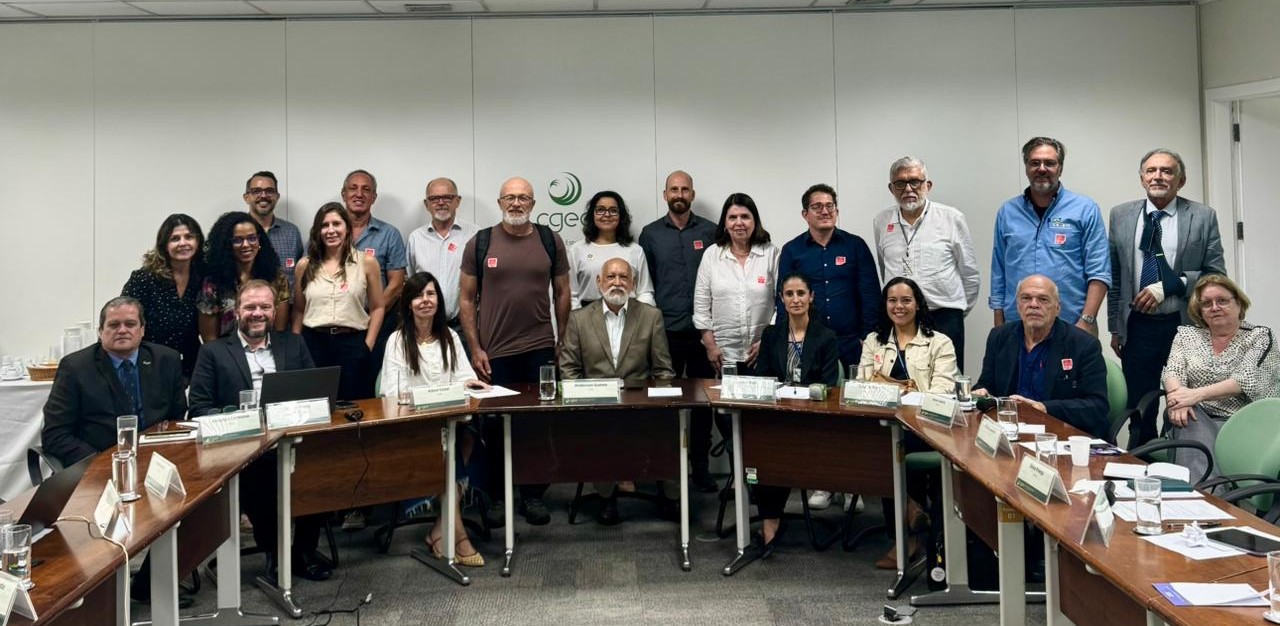
Among the topics discussed were the global scenario and its implications for Brazil, the main national actors and priorities, as well as the construction of a new strategic roadmap for the period 2026–2040.
The Center for Management and Strategic Studies (CGEE) held, this Wednesday (22), a workshop dedicated to updating the prospective study on rare earths in Brazil, with a horizon up to 2040. The initiative brought together researchers, specialists and representatives of strategic institutions to discuss the challenges and opportunities related to the development of these production chains in the country.
The opening of the meeting was led by the CEO of CGEE, Anderson Gomes, with the participation of directors Connie McManus and Geraldo Nunes, reinforcing the institution's role as an articulator of strategic knowledge aimed at the formulation of public policies in science, technology and innovation.
The event also featured a lecture by Professor Silvio Meira, from the Center for Advanced Studies and Systems of Recife (Cesar) and TDS Company, two of the most relevant institutions in the country in innovation and technology, who addressed strategic aspects to be incorporated into the study. Also participating were the director of the Department of Innovation Programs (Depin) of the Ministry of Science, Technology and Innovation (MCTI), Osório Coelho Guimarães Neto, and his team, as well as Ronaldo Carmona, from the Superior War College (ESG) and the Financing Agency for Studies and Projects (Finep).
The workshop marks a new cycle of updating a topic that has already mobilized CGEE for over a decade. In 2013, the institution published the study "Uses and applications of rare earths in Brazil: 2012–2030," prepared based on a request from the Ministry of Science, Technology and Innovation (MCTI). At the time, the objective was to structure a strategic agenda for the development of these production chains, including the construction of global scenarios, the definition of a national roadmap, and the identification of drivers for sectors such as permanent magnets, catalysts, metal alloys, and matches.
More than ten years later, the topic returns to the public agenda in light of geopolitical reconfiguration and the global energy transition. Rare earth elements are essential inputs for technologies such as wind turbines, electric vehicles, medical equipment, defense systems, and advanced electronic devices. In this context, the workshop sought to update diagnoses, review strategies, and point out paths for strengthening Brazilian technological autonomy.
The event's program reflected the complexity of the production chain and the need for an integrated approach. Among the topics discussed were the global scenario and its implications for Brazil, the main national actors and priorities, as well as the construction of a new strategic roadmap for the period 2026–2040. Critical stages of the chain were also addressed, such as mining, concentration, refining – including the separation of oxides by solvent extraction – and the development of industrial applications.
Invited experts presented strategic guidelines for different segments, such as the production of permanent magnets, catalysts, metal alloys, matches, and materials for polishing and manufacturing special glasses and lenses. The agenda also included discussions on circular economy and sustainability, reflecting the growing concern about the responsible use of these resources.
The debates were led by names such as Fátima Ludovico, Fernando Landgraf, Fernando Lins, Mariele Bonfante, Juliano Engerroff, and Wagner Macedo, among other experts with recognized expertise in the field.
According to the CEO of CGEE, the diversity of participants demonstrates the Center's effort to combine scientific and institutional expertise to address a challenge that is simultaneously technological, industrial, and strategic.
“This coordination effort is not a one-off event. It is part of CGEE’s historical mission to connect scientific production, strategic analysis, and public decision-making. By bringing together researchers, research centers, and institutional actors, the Center contributes to consolidating an evidence base capable of guiding more robust and coordinated public policies. We will deliver the results to Minister Luciana Santos [MCTI] and President Lula,” stated Anderson Gomes.
ABC speaks out - The relevance of this agenda is reinforced by recent diagnoses from the scientific community. A technical note published by the Brazilian Academy of Sciences (ABC) in December 2025 highlights that Brazil holds approximately 23% of global rare earth reserves, but still does not master higher value-added stages, such as refining, metallurgy, and the manufacture of permanent magnets. The document also points to the persistence of gaps already identified in previous studies by CGEE itself, especially regarding the lack of infrastructure for industrial scaling up.
“In this scenario, updating the prospective study takes on strategic importance. By reviewing scenarios, identifying bottlenecks, and proposing guiding principles, the work contributes to aligning mineral, industrial, energy, and defense policies in a context of increasing global competition for critical resources,” Gomes concluded.
The CGEE proposal signals a movement towards continuity and deepening of a state agenda, reinforcing its role as a space for the collective construction of strategies for national development in science, technology, and innovation.
Access the study "Uses and applications of rare earths in Brazil: 2012–2030" here .