CGEE hosts ECLAC event on green innovation and interaction between ICTs and companies.
14 of September, 2026
Share:
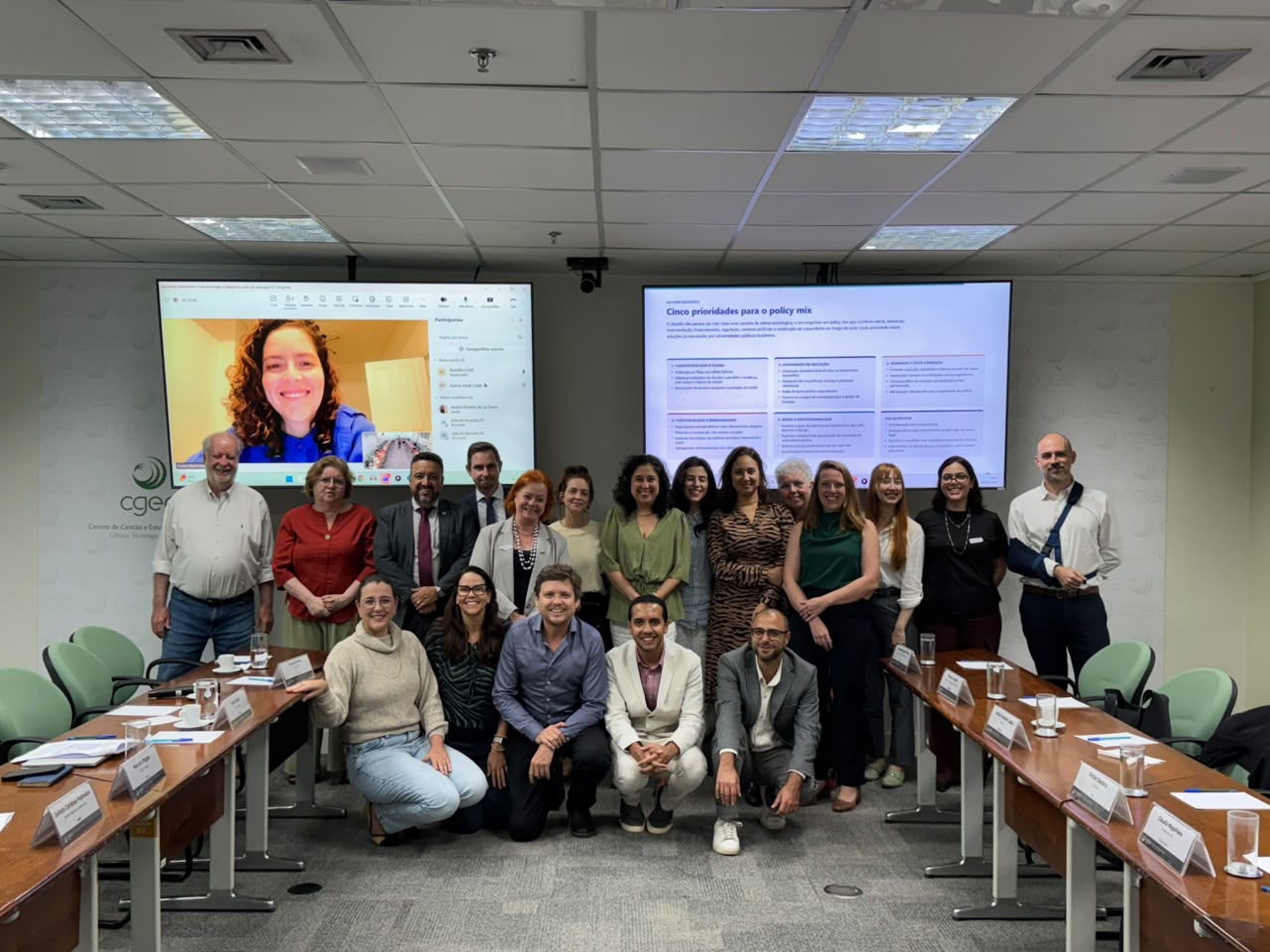
The meeting brought together more than 30 representatives from different institutions to discuss governance, funding, and public policies aimed at cooperation between universities and the productive sector.
Last Thursday (September 10th), the Center for Management and Strategic Studies (CGEE) hosted the event “Accelerating the Brazilian ecological transformation through ICT-business interaction,” promoted by the Economic Commission for Latin America and the Caribbean (ECLAC). The initiative brought together more than 30 participants from government agencies, universities, research institutions, innovation funding entities, and the productive sector in Brasília.
Long-standing partners, CGEE and CEPAL promoted the debate on ways to strengthen cooperation between Science and Technology Institutions (ICTs) and companies, as well as to expand the articulation between public policies aimed at green productive development.
During the event, ECLAC presented the results of a study on experiences of interaction between public universities and companies that achieved positive results in the development of innovations aligned with ecological transformation. The research analyzed seven case studies and involved 51 interviews with 78 stakeholders from all regions of Brazil.
The study identified different governance models and cooperation modalities, as well as bottlenecks that still limit the continuity and expansion of these initiatives. The analysis also gathered lessons and opportunities for improving public policies aimed at innovation and national technological development.
Participants were able to comment on the results presented by ECLAC, share institutional experiences, and propose alternatives for the continuation of the agenda. The discussions addressed aspects related to the governance of interactions between universities and companies, financing mechanisms, and the capacity to influence public policies.
The regulatory challenges faced by universities and ICTs, the importance of territorial vocations and specializations, and the conditions necessary to transform successful experiences into larger-scale initiatives were also discussed.
Green productive development
The opening ceremony included the participation of the Director of Projects and Institutional Relations at CGEE, Connie Macmanus; the Director of the ECLAC Office in Brazil, Camila Gramkow; the General Coordinator of Green Innovation at the Secretariat of Economic Policy of the Ministry of Finance, Carina Vitral; and the Special Advisor to the Ministry of Finance, Rafael Dubeux.
The first panel presented the seven case studies and addressed governance models and the institutional framework of innovation in interactions between universities and companies. In the second stage, moderated by Marcos Arcuri from CGEE, the debate focused on financing mechanisms and the regulatory framework, considering its limitations and opportunities.
The meeting concluded with a discussion on perspectives and priorities for accelerating innovation aimed at ecological transformation in Brazilian universities. Participants pointed out possibilities for further study and continued collaboration between the institutions involved.
This initiative is part of a broader agenda for producing evidence and technical support for green productive development. In Brazil, this debate directly engages with the Ecological Transformation Plan and the New Industry Brazil initiative, especially in the effort to connect the knowledge produced by universities with the country's productive and technological capabilities.