CGEE Director Anderson Gomes discusses science, innovation, and scientific management in an interview on the InterD program.
5 of September, 2025
Share:
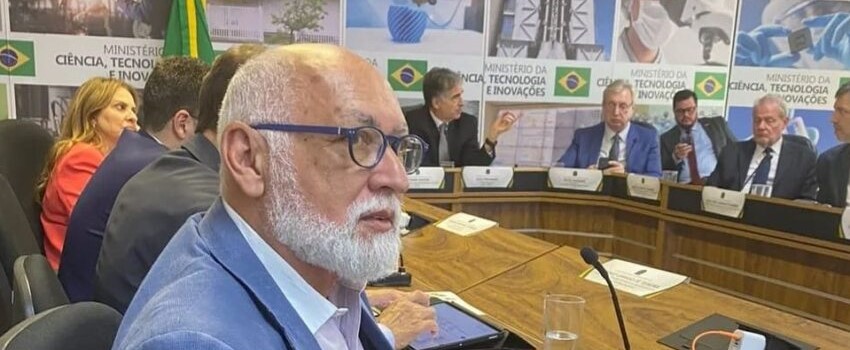
In the conversation, he highlighted his career at the Federal University of Pernambuco (UFPE), his work at CGEE, and his coordination of the 5th National Conference on Science, Technology and Innovation, which resulted in the creation of the group responsible for the National Strategy for Science, Technology and Innovation for the next ten years.
Throughout the interview given to the InterD – Science and Culture program, the director of CGEE, Anderson Gomes, recalls his trajectory in science and scientific management, marked by his dedication to postgraduate studies, the coordination of the 5th National Conference on Science and Technology, and his current work at the Center for Management and Strategic Studies, where he works on the development of studies and in supporting science, technology, and innovation policies.
The full interview follows below:
“We will not give up on Brazil.” The phrase, uttered by the former governor of Pernambuco and then-candidate Eduardo Campos in the 2014 presidential election, was repeated by the president of the Pernambuco Academy of Sciences, Anderson Gomes. A scientist and professor at the Federal University of Pernambuco (UFPE), Gomes participated in the InterD – Science and Culture program, broadcast on September 3rd on Universitária FM in Recife and on major streaming platforms.
In the conversation, he recalled that his initial motivation was not science, but teaching, inspired by his mother, who was a teacher. "I didn't have that experience of looking at science from an early age because I didn't have that opportunity. I discovered that there was a shortage of physics teachers and I followed that path," he says.
InterD – Professor, how did your interest in science begin?
Anderson Gomes – I didn't have that experience of looking towards science from an early age because I didn't have that opportunity. My initial motivation was to be a teacher, like my mother, who was also a teacher. I discovered that there was a shortage of physics teachers and I followed that path.
During my undergraduate studies in Physics at UFPE, in my third year, I came into contact with the laboratory and the world of science. I finished my undergraduate degree already involved in scientific initiation. Afterwards, I took bachelor's level courses to broaden this perspective, went on to do a master's degree in Pernambuco and a doctorate abroad.
I returned to Brazil in the late 1980s, and since then science has become my path. Back then, there weren't as many opportunities to engage with science as there are today. Those from wealthier families had access to films or books; in my case, it depended solely on school, which also didn't cover science in a comprehensive way. Today, although still insufficient, this scenario has improved considerably.
InterD – And currently, what do you do for a living?
Anderson Gomes – I spent many years solely as a professor and researcher at the university. Later, I became involved in scientific management: I was the scientific director at the Technological Institute of Pernambuco, Secretary of Science, Technology and Innovation under Eduardo Campos, and also Secretary of Education.
One of the programs I'm most proud of is Ganho Mundo, which takes high school students on exchange programs abroad. It has become a state policy and has transformed the lives of many young people.
Today I remain involved in postgraduate studies at UFPE and work at the Center for Management and Strategic Studies (CGE), an organization linked to the MCTI (Ministry of Science, Technology and Innovation). There we work on future studies and support for national policies. Together with Professor Sérgio Rezende, I coordinated the 5th National Conference on Science and Technology. The result was the creation of a group that is developing the National Strategy for Science, Technology and Innovation for the next 10 years. Currently, my life is divided between science, innovation, and scientific management.
Notable people
InterD – Who contributed most to your education?
Anderson Gomes – The first was my mother, Eunice Leonidas Gomes, a Portuguese teacher. She had ten children, made sure they all studied, and taught me persistence and resilience.
In high school, a drawing teacher said something that stuck with me: "Always help people climb the stairs without pushing anyone down."
At university, I was chosen by a professor who wasn't just looking for the best students: José Roberto Rios Leite. He mentored me in my scientific initiation program, always supported me, and continues to be a role model.
Later, during my postdoctoral studies, I worked with colleagues abroad. One of them was the French scientist Anne L'Huillier. We collaborated on the creation of a laboratory and published together. Decades later, in 2023, she received the Nobel Prize. It was thrilling to realize that I had been present at the beginning of her journey.
These people – my mother, José Roberto, and Anne – are fundamental milestones in my journey.
Pernambuco Academy of Sciences
InterD – And what is the purpose of the Pernambuco Academy of Sciences?
Anderson Gomes – The Academy was created more than 80 years ago. In the last ten years, it has undergone a process of renewal, becoming more rigorous and active. I joined about five years ago and today I am president, recently re-elected to the position.
Our goal is to bring science closer to the people of Pernambuco, combating misinformation and disseminating knowledge in an accessible way. For example, we maintain a weekly column in the Jornal da Cidade newspaper.
We also seek to engage in dialogue with governments and institutions, providing technical opinions on relevant topics. We want to expand our activities to schools throughout the state, training teachers and disseminating science. The Academy has approximately 100 volunteer scientists and plans to open its doors to institutional members, including companies interested in contributing.
Our role is to show that science is everywhere: from cell phones to the environment, from biodiversity to everyday technologies.
Science education
InterD – You mentioned education. How do you see the current situation?
Anderson Gomes – Today, it's not enough to fill the board with formulas. We need to show how science is present in everyday life. The pandemic reminded us of this: masks, CT scans, vaccines, everything stems from scientific research that began decades earlier.
The problem is structural. Elementary school teachers often don't receive adequate training or pay, leading them to reproduce outdated content. This creates a vicious cycle. But we are already seeing changes, with more attention paid to teacher professional development and the integration of science into daily school life.
The key is to bring science into the students' reality. Only in this way will we spark interest and create well-prepared citizens.
The future of science in Brazil.
InterD – What are your hopes for the future of science in the country?
Anderson Gomes – Today I participate in the group that is developing the National Strategy for Science, Technology & Innovation for the next ten years. The dream is that what we plan will move from paper to reality and become state policy, not just government policy.
We have examples of success, such as the SUS (Unified Health System) and Proálcool (Economic Program for Alcohol Production). We need to invest in education, decentralize universities and institutes, spreading opportunities throughout Brazil, as China did.
The future depends on a social pact and a long-term vision. Education, science, and technology are the foundation of economic and social development.
Indications and Interdisciplinarity
InterD – What books or films do you recommend to spark an interest in science?
Anderson Gomes – Rather than providing a list, I suggest that each person seek out what sparks their curiosity. Today we have entire libraries in the palm of our hand, on our cell phones. It's important to learn how to filter reliable information.
I always advocate for interdisciplinarity. Although I am a physicist, I have worked in dentistry for over 20 years, applying techniques from physics. Science needs to engage in dialogue with different areas, including culture and the arts.
One example is physicist Neil deGrasse Tyson, who speaks about scientific literacy. He reminds us that we don't want everyone to be a scientist, but rather that everyone should have a critical view of the world.
The key is to study the basics – language, mathematics, and science – in order to solve problems that don't even exist yet.
InterD – Would you like to leave a final message?
Anderson Gomes – I appreciate the invitation and I echo a phrase by Eduardo Campos: “We will not give up on Brazil.” We need to be resilient, persevere, and believe that it is possible to build a better future based on science, education, and innovation.
Source: with information from InterD - science and culture
Related news
Estudo sobre os INCTs ganha destaque em editorial do Jornal da Ciência
3 of June, 2026Texto assinado pela presidente da SBPC destaca avaliação conduzida pelo CGEE e CNPq e defende os institutos como infraestrutura estratégica para a soberania científica nacional.
Superlive broadcast of 'Projeto Brasil' this Thursday discusses the national strategy for Science and Technology.
9 of October, 2025Industry leaders, such as Francilene Garcia (president of SBPC) and Luis Fernandes (executive secretary of MCTI), are discussing how the country can expand integration between universities, companies, and government in the new National Science and Technology Strategy. CGEE will be represented in the debate by its CEO, Fernando Rizzo, and director Anderson Gomes.
Survey analyzes racial diversity among master's and doctoral degree holders.
25 of September, 2025Black and mixed-race people have limited access to postgraduate studies, but those who graduate have good access to formal employment.