CGEE Director presents the Brazilian Artificial Intelligence Plan at a strategic seminar at Finep.
17 of October, 2025
Share:
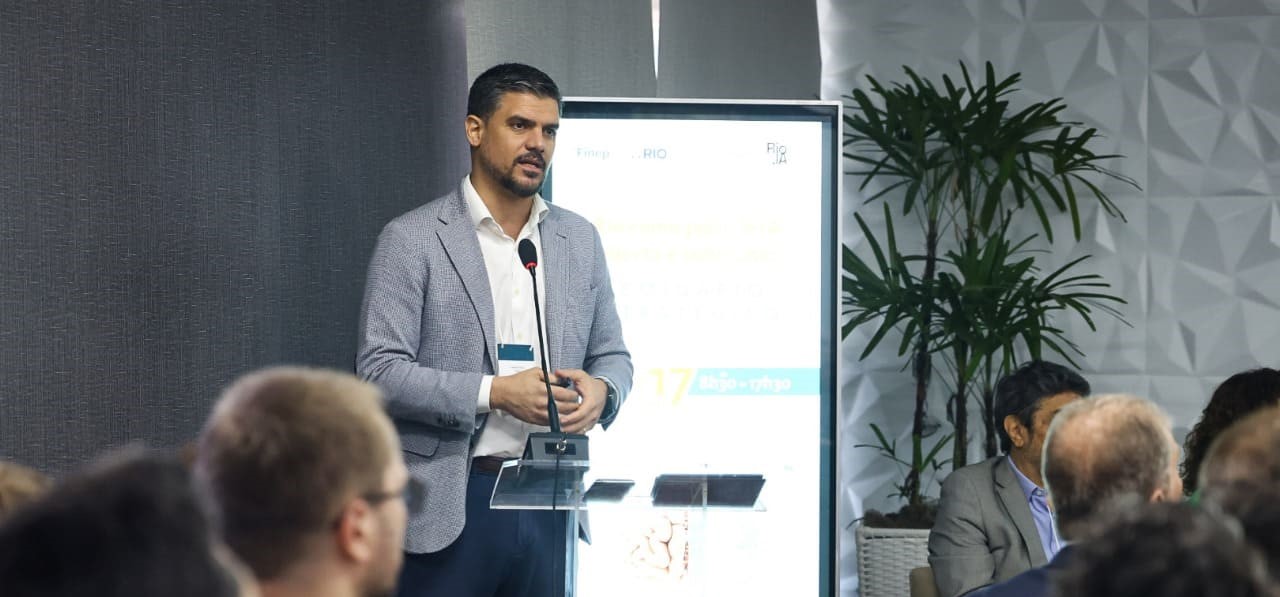
The event discussed Rio de Janeiro's role as a hub for open and sovereign AI and sought to map the infrastructure and collaboration to guide the development of public AI policy.
The director of the Center for Management and Strategic Studies (CGEE), Caetano Penna, presented yesterday (16), during the seminar “Rio as a hub for open and sovereign AI”, the main results and perspectives of the Brazilian Artificial Intelligence Plan (PBIA). The event was held at the headquarters of the Financing Agency for Studies and Projects (Finep), in Rio de Janeiro (RJ).
Penna, who supervised the project supporting the development of the PBIA, highlighted that the plan is the result of a participatory and inter-institutional process, initiated after the challenge launched by President Luiz Inácio Lula da Silva in 2024 to create a national AI policy capable of driving the sovereign, ethical, and inclusive development of the country.
“Following that meeting of the National Council for Science and Technology, President Lula challenged the scientific community and the Ministry of Science, Technology and Innovation to build a national AI plan. The PBIA (Brazilian Program for the Innovation of AI) was born from this challenge, with a human-centered vision, oriented towards overcoming social challenges and grounded in national sovereignty,” stated the director.
During the presentation, the director explained that the plan consolidates existing actions and incorporates new structuring initiatives, articulated around five main axes: business innovation, infrastructure and development, training and capacity building, public services, and governance and regulation.
The PBIA (Brazilian Program for Innovation and Development) foresees investments of approximately R$ 23 billion over five years, with 80% coming from the National Fund for Scientific and Technological Development (FNDCT), managed by Finep, which guarantees the program's financial sustainability. The plan was developed based on input from 117 institutions and more than 300 proposals received in workshops with representatives from academia, government, the private sector, and civil society.
The presentation also provided data on the plan's progress: 54 structuring actions are underway, with 25 already delivered and 16 initiated. Finep and the National Bank for Economic and Social Development (BNDES) are the main financing agents, with more than R$ 5 billion already approved in direct investments. "We want to create a national artificial intelligence ecosystem that unites research, innovation, and talent development, promoting the use of AI for the social, economic, environmental, and cultural development of Brazil," stated Penna.
In conclusion, the director highlighted the strategic potential of the city of Rio de Janeiro as a center for research and innovation in AI. According to him, the city brings together universities of excellence, consolidated centers, cutting-edge digital infrastructure, and an expanding innovation ecosystem.
“Rio has all the conditions to translate the PBIA into concrete local actions, articulating the federal level with regional initiatives. Mobilizing municipal data and strengthening the AI ecosystem in Rio de Janeiro is an important step towards consolidating Brazil as a reference in open and sovereign artificial intelligence,” he concluded.
About PBIA
Launched in 2024, the Brazilian Artificial Intelligence Plan (PBIA) proposes the ethical, responsible, and sovereign use of AI as an instrument for transforming national development. Its objective is to foster innovation, strengthen the country's scientific and technological capacity, and ensure that artificial intelligence contributes to social well-being, digital inclusion, sustainability, and Brazilian sovereignty.
The plan is a strategic initiative of the National Council for Science and Technology (CCT), of the federal government, under the coordination of the Ministry of Science, Technology and Innovation (MCTI), with the support of the Center for Management and Strategic Studies (CGEE), which guides the ethical, safe and sustainable development of artificial intelligence in Brazil.
With planned investments of up to R$ 23 billion over four years, the PBIA (Brazilian Program for the Innovation and Development of AI) seeks to strengthen the national capacity for research, innovation, and application of AI in public services and strategic sectors. Among its goals are the acquisition of one of the world's most powerful supercomputers, the promotion of talent development, the creation of transparent regulatory environments, and the encouragement of AI adoption as a tool for national development.
Related news
The Brazilian Artificial Intelligence Plan is presented by CGEE at an international workshop.
21 of January, 2026The Center's Director presented the PBIA at an international event on science, defense, and strategic technologies.
Pbia working group launches action monitoring panel.
1 of December, 2025The information is provided by the agencies participating in the plan. At the next meeting, in January, a report on the first year of the initiative will be presented.
CGEE Director participates in Senate hearing on the Brazilian Artificial Intelligence Plan (PBIA)
22 of October, 2025On that occasion, Caetano Penna highlighted the Center's contributions to the Brazilian Artificial Intelligence Plan and the importance of integrating research, innovation, and public policies for the advancement of AI in the country.