CGEE Director Moderates Debates on Competitiveness, Scalability, and Health at OECD Conference on Missions
25 of September, 2026
Share:
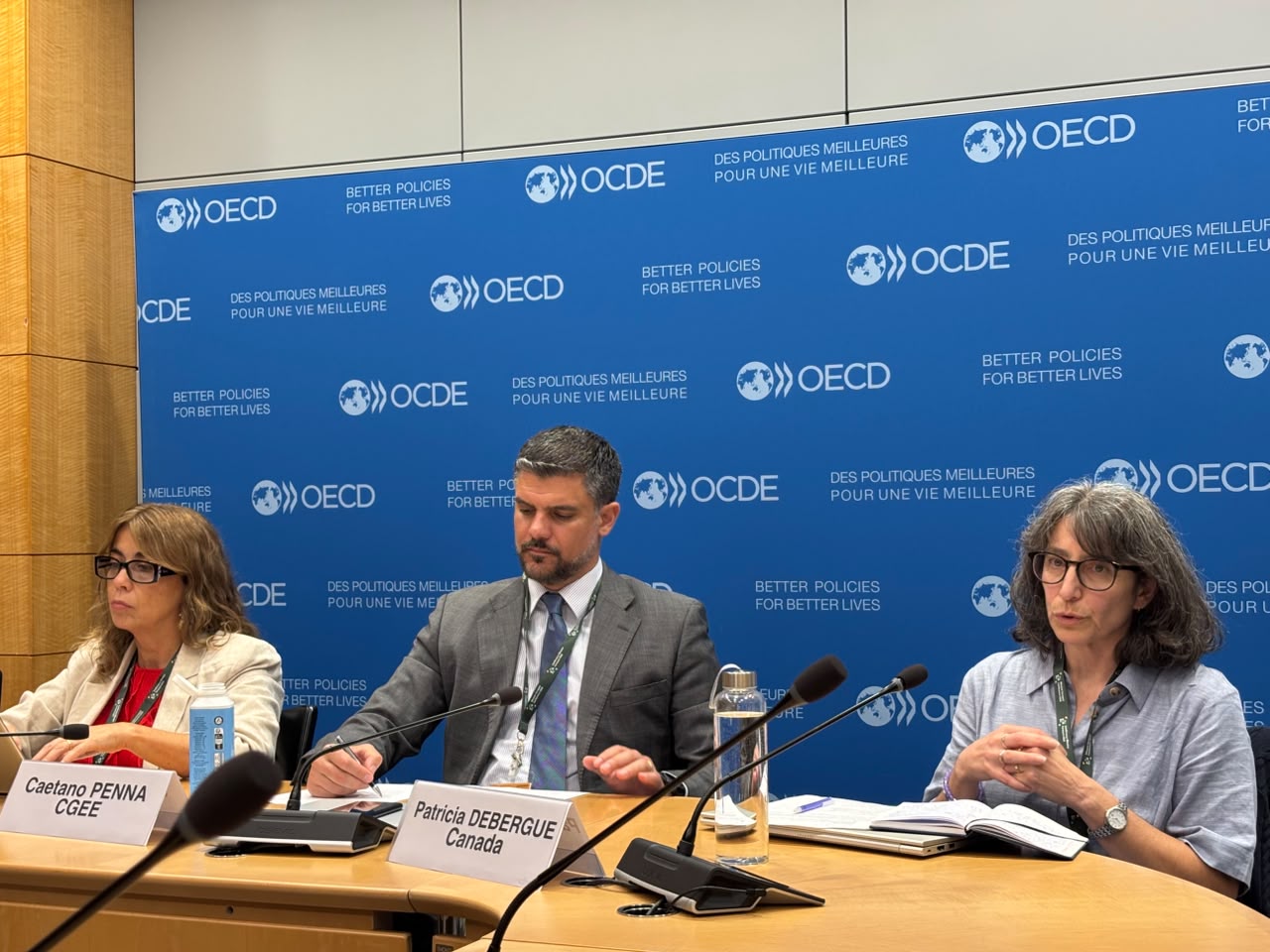
The meeting in Paris brought together 290 policymakers, mission managers, and academics from 33 countries.
Caetano Penna, Director of Strategic Projects and International Relations at the Center for Management and Strategic Studies (CGEE), participated in the Mission Forward Conference 2026 on September 24th and 25th. The conference was organized by the Organisation for Economic Co-operation and Development (OECD) at its headquarters in Paris, with the theme "Shaping the Future Through Mission-Oriented Policy". The meeting was convened by the OECD's Committee on Science and Technology Policy (CSTP), with support from the Directorate-General for Research and Innovation of the European Commission, within the framework of the partnership between the Commission and the OECD on missions.
A total of 290 people participated, representing 52 mission-oriented initiatives and 49 missions in 33 countries. This was the second edition of the event, which first met in Vienna in 2024. The discussions will contribute to a key OECD publication scheduled for 2027.
Penna is part of the academic council that supports the OECD in preparing for the conference and has been invited to moderate two sessions.
Competitiveness and scaling
On the first day, he led one of the thematic sessions on competitiveness and mission scaling. The sessions followed a fishbowl format, in which participants take turns at the center of the discussion circle. In his opening remarks, Penna revisited the formulation of missions, one of the central themes of the 2024 edition. According to him, discussing competitiveness requires looking at the type of change the mission intends to produce, and not just the participation of the private sector.
"Many governments today want missions that increase productivity and competitiveness. The question is how to adapt the mission approach to this challenge and make it compatible with environmental sustainability, climate change mitigation, and social inclusion. We need to promote competitiveness without abandoning the welfare state," he stated.
Penna highlighted the legitimacy that economic missions can have, as they address issues directly felt by citizens, such as employment, income, and cost of living. This legitimacy, however, depends on social inclusion and visible results in the short term. He also argued that workers and unions should have a place in the governance of these missions.
Regarding scaling up, the director warned against the so-called "R&D trap." "Many missions originate in ministries and science and technology agencies, whose instruments are good for generating solutions, but not very effective in getting them adopted. Scaling up requires passing the baton to innovation agencies, development banks and investment funds, as well as to regulators and purchasers," he explained. Penna also raised a fundamental question: when can a mission be considered accomplished, and at what point should mission-driven policy give way to other policies that further disseminate solutions?
Missions in healthcare
On the second day, Penna moderated the parallel session on missions in the health field, with two guests: Anabela Isidro, coordinator of the European ECHoS project at the Agency for Clinical Research and Biomedical Innovation (AICIB) in Portugal. The project supports the creation of national hubs for the European Union's Cancer Mission; and Patricia Debergue, director of the Aging in Place Challenge program at the National Research Council of Canada, focused on the quality of life of older adults and their caregivers.
"Health is one of the areas where the results of a mission reach the citizen most directly, which gives these missions great legitimacy. The challenge is to go beyond a vision centered on medications and treatments and transform the system that provides care, with the participation of patients, caregivers, and health professionals," he said.
Relevance to Brazil
The topics discussed are relevant to the Brazilian agenda. The New Industry Brazil, the federal government's industrial policy, is organized into six missions, and CGEE supports the Ministry of Science, Technology and Innovation (MCTI) with studies, monitoring, and evaluation of S&T policies. "The international debate on missions has entered the implementation, scaling, and evaluation phase. This is the same phase Brazil is in, and there is much to learn from the experiences presented here," Penna assessed.
Related news
CGEE promotes side event at SB64 on technology, innovation and climate solutions.
8 of June, 2026A session held in partnership with international organizations will discuss how Belém's Technological Implementation Program and public digital infrastructure can accelerate data-driven climate solutions.
ABDE brings international debate on financing the green transition to Rio.
29 of May, 2026An event held on June 2nd will bring together national and international experts to discuss innovative climate finance instruments for the sector.
CGEE reinforces international action on climate agenda during ministerial meeting in Denmark.
22 of May, 2026The Center's participation in the 5th Climate Ministerial highlights Brazil's contribution to the debate on technological implementation, climate finance, and cooperation within the UNFCCC.