National Meeting on the Popularization of Science initiates debates on public perception and strengthening policies for the sector.
4 of December, 2025
Share:
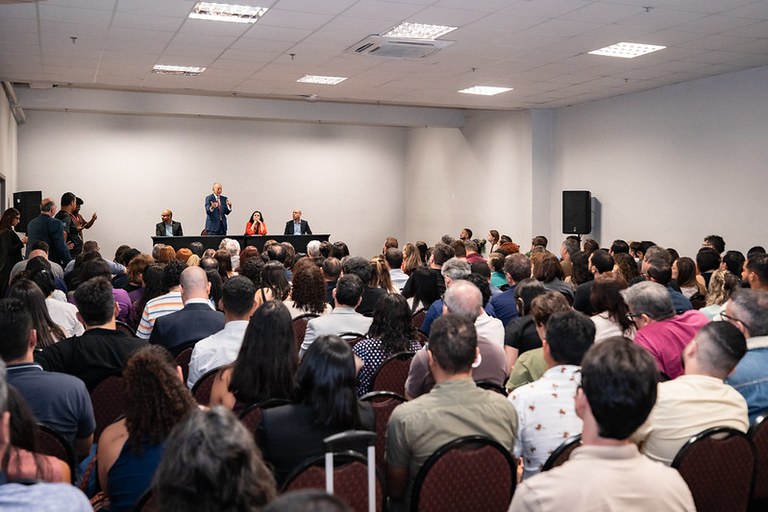
Photo: Rodrigo Cabral (ASCOM/MCTI)
On the first day of the event, on Tuesday (2), experts highlighted the challenges the country faces in expanding investments and assessed Pop Ciência. The program continues until Thursday (4).
Evento reúne professores de universidades e institutos federais, estudantes, pesquisadores, especialistas e representantes do MCTI e de suas vinculadas.
The National Meeting for the Popularization of Science began on Tuesday (2) and brought together professors from universities and federal institutes, students, researchers, specialists and representatives from the Ministry of Science, Technology and Innovation (MCTI) and its affiliates, such as the National Council for Scientific and Technological Development (CNPq). The event continues until Thursday (4), with a program dedicated to scientific dissemination, network building and evaluation of public policies.
The opening panel included the Secretary of Science and Technology for Social Development (Sedes), Inácio Arruda; the director of the Department of Popularization of Science, Technology and Scientific Education of the MCTI, Juana Nunes; the Secretary of Science, Technology and Innovation of Bahia, Marcius Gomes; and the coordinator of programs in the area of Education, Popularization and Scientific Dissemination of the CNPq, Guilhermo Vilas Boas.
Inácio Arruda contextualized the current scenario for science, technology, and innovation policies and emphasized that popularization programs are fundamental to sustaining strategic investments. “Popularizing science means engaging with communities, transforming cities with scientific events, and bringing knowledge closer to Brazilian families. Without this, we cannot consolidate the advances that the country needs,” he stated.
Results
During the first panel of the day, the latest findings from the Public Perception of Science and Technology Survey, conducted by Adriana Badaró, a technician from the Center for Management and Strategic Studies (CGEE), were presented. She emphasized the importance of the historical series that began in 1987. "This research serves as a basis for formulating public policies, evaluating programs, assessing our outreach efforts, and, most importantly, understanding the population's behavior in relation to science and technology," she explained.
She highlighted that the resumption of the department's outreach efforts in recent years is already reflected in the new data and reminded that the study, conducted every four years, seeks to innovate methodologically and expand the use of information by universities, researchers, and managers. “In addition to trying to understand attitudes and behaviors, we seek to innovate. And we need this data to be used. More than just presenting results, we want them to serve to guide policies and actions,” she concluded.
Following this, Guilhermo Vilas Boas presented an evaluation of Pop Ciência and reinforced the importance of consolidating a national policy focused on science communication. “We have seen a true convergence emerge between different actors in science communication throughout the country. Projects that previously occurred in isolation, in various regions and institutions, began to dialogue and coordinate until it was possible to consolidate, by decree, mechanisms that structure a national public policy for the popularization of science. This result is the fruit of hard work by the MCTI, CNPq, and the teams involved,” he explained.
Closing the panel, director Juana Nunes emphasized the structuring role of science popularization in social development and civic education. “The work we do at MCTI is sometimes seen as a task solely for basic education or the Ministry of Education [MEC], but it isn't. Science popularization isn't something occasional. It's what builds knowledge and influences the choices of each citizen,” she stated.
Schedule
The meeting's schedule continues this Wednesday (3) with the participation of the Minister of Science, Technology and Innovation, Luciana Santos. In the afternoon, the event will host the panel Institutional Articulation and Perspectives of the Mais Ciência na Escola Program, with representatives from CNPq, MEC and MCTI, followed by the panel The Construction of the Pop Ciência Ecosystem in the States, which will bring together state secretariats of science, technology and innovation and the São Paulo State Research Support Foundation (Fapesp) to discuss regional implementation strategies.
On Thursday (4), the meeting will be dedicated to the regional working groups, North, Northeast, Midwest, Southeast and South, which will consolidate proposals and directions to strengthen actions to popularize science throughout the country.
Source: Ministry of Science, Technology and Innovation - MCTI.
Related news
After years of decline, public investment in science and technology advances 30% in the country.
18 of June, 2026A study released this Tuesday (16) shows that Brazil interrupted the downward trajectory of resource transfers and resumed funding for research.
Public perception of science is key to Brazil's development.
11 of May, 2026This video highlights the role of science, technology, and innovation in everyday life and in building the future. Access the link in the article!
CGEE Director participates in the launch of the Science, Technology and Innovation Agenda for the Pantanal.
3 of February, 2026In addition to outlining the institute's goals up to 2030, the project reaffirms the importance of valuing traditional knowledge and water security in the region.