Climate intelligence gains traction in BRICS and guides strategic decisions.
16 of April, 2026
Share:
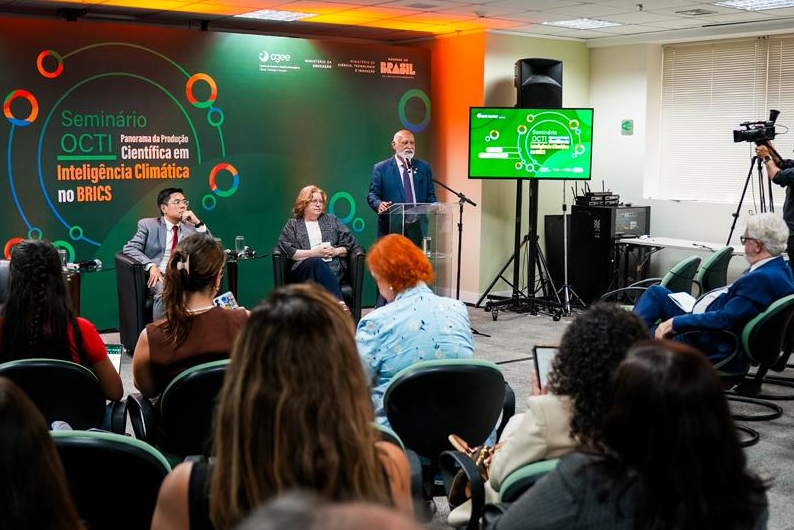
Photo: Daniel Lebre/CGEE
A seminar organized by CGEE brought together experts to discuss trends, capabilities, and opportunities for Brazil to address climate challenges.
Qualified information, international cooperation and strategic use of science are ways to face climate challenges and guide more efficient public policies. With this focus, the Center for Management and Strategic Studies (CGEE), a unit linked to the Ministry of Science, Technology and Innovation (MCTI), held this Thursday (16) the OCTI Seminar — Overview of Scientific Production and Climate Intelligence in the BRICS. The event brought together experts to discuss trends, capabilities and opportunities for Brazil's role in the global scenario.
The meeting is part of the CGEE's 25th anniversary program and aims to improve evidence-based decision-making. The initiative also broadens the debate on scientific cooperation among BRICS countries, a bloc that brings together emerging economies with a growing role in knowledge production and technological development.
During the opening, the head of the Special Advisory Office for International Affairs at the Ministry of Science, Technology and Innovation (MCTI), Carlos Matsumoto, highlighted the strategic role of information in international coordination. "I think that this work of gathering information, of learning more and having a clear understanding of what benefits we want from these collaborations is fundamental," he stated.
The seminar is an offshoot of the OCTI 2024 Annual Bulletin, published in 2025, which analyzes the evolution of scientific production in climate intelligence within the BRICS context. The program included debates on the potential for collaboration in science, technology, and innovation, as well as the presentation of recent indicators and studies.
According to the president of CGEE, Anderson Gomes, the challenge goes beyond data production and involves its practical application. “We have the capacity to generate good studies and disseminate them widely, but we still face difficulties in ensuring that this knowledge actually reaches those who need to use it in decision-making. We have intensified our work with ministries and other stakeholders to contribute more and more to evidence-based policies,” he said.
Currently composed of 11 countries, BRICS represents more than 40% of the world's population and approximately 41% of global GDP in purchasing power parity. In this context, strengthening scientific cooperation and the use of evidence become crucial for addressing common challenges, such as climate change, and expanding the response capacity of countries in the Global South.
New OCTI Report
During the seminar, the eighth edition of the OCTI Report was launched, which delves deeper into the analysis of climate intelligence and reinforces the use of data in defining public strategies and in Brazil's international actions.
The study points to a rapidly expanding field, driven by the integration of climate science, artificial intelligence, and energy technologies. From 2022 to 2025, 32,040 articles on the subject were published, of which 17,460 involved BRICS countries, equivalent to 54.5% of global production. During this period, the annual volume of publications more than doubled, indicating the advancement of this agenda in areas such as engineering, environmental sciences, and climate modeling.
The survey also shows that Brazil has a significant presence in areas such as bioenergy, resilient agriculture, and studies on biomes like the Amazon and Cerrado. At the same time, it highlights the concentration of scientific production in a few countries and the low level of cooperation among members of the bloc, signaling room for expanding partnerships and developing joint solutions to climate challenges.
See the full report.
Source: Ministry of Science, Technology and Innovation - MCTI
Related news
Vice-presidente regional da ABC representa o Brasil no Brics Science Academies Forum 2026
22 of July, 2026Vice-presidente Regional Nordeste e Espírito Santo da Academia Brasileira de Ciências, Anderson Gomes integra a delegação brasileira em encontro que reúne academias nacionais de ciências dos países do Brics.
CGEE promotes presentation on international cooperation in Science, Technology & Innovation with researcher from STINT.
26 of March, 2026The program was designed with a focus on exchanging experiences in R&D, artificial intelligence, and supercomputing.