The initial milestone of the Innovation Diplomacy Project defines five strategic areas of action.
2 of June, 2026
Share:
An initiative led by CGEE and MRE will produce evidence, indicators, and diagnoses to support Brazil's international performance in priority technological areas.
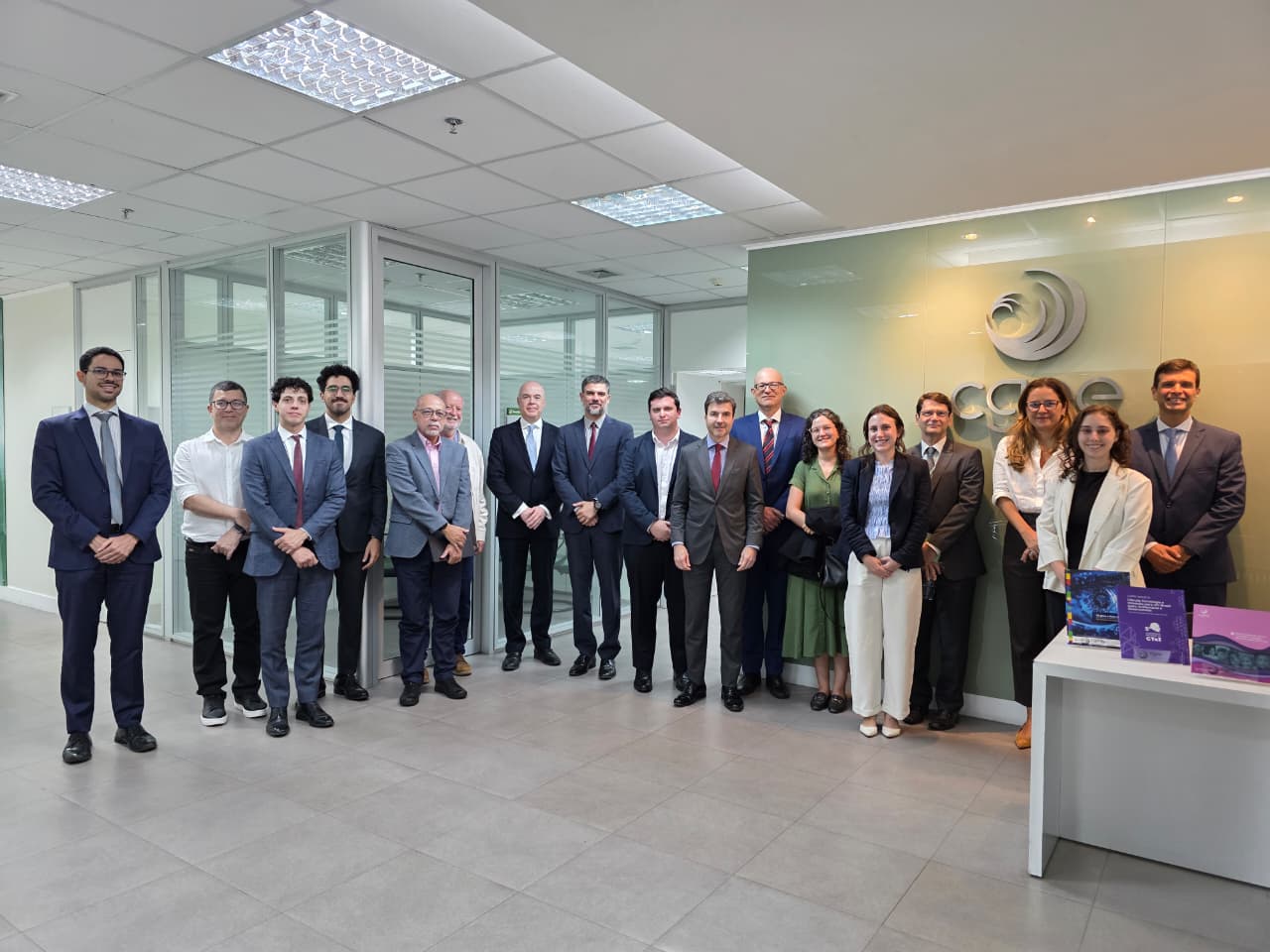
The presentation meeting for the Initial Framework of the Innovation Diplomacy Project (PDI) brought the first strategic surveys of the products that will be delivered in partnership with the Center for Management and Strategic Studies (CGEE) and the Ministry of Foreign Affairs (MRE). The meeting took place on Monday (1st) at the Center's headquarters in Brasília (DF).
The plan is structured around five strategic tracks, ranging from monitoring public policies to analyzing the scientific diaspora and participating in megascience projects. One of the central objectives is to create rigorous methodologies, such as the use of logical models, to assess the real impact of technological investments and Brazil's international integration. Furthermore, the initiative seeks to map the national potential in areas such as artificial intelligence and climate technologies to attract external partnerships.
At the event, the Director of Strategic Projects and International Relations at CGEE, Caetano Penna, presented the five work tracks of the initiative, whose central objective is to produce evidence to support Brazilian foreign policy in science, technology and innovation (ST&I). He highlighted the meticulous exploration of aspects of the Institutional Development Plan (PDI) structuring that the Center can promote.
“Within the scope of the Innovation Diplomacy Program itself, some aspects perhaps require a more in-depth look. The first is the aspect of the internationalization of our National Science and Technology System. The second is a gap in the perception of Brazilian capacity, more in the technological field than in science, and in the field of innovation, and the external perception of potential partners. And the third, the last point, is that this translates into the stages of this project. We at CGEE realize this; we support different bodies here at the ministerial bases, but we also work with diplomatic representations,” Penna explained.
With a planned duration of 20 months, the project uses collaborative workshops to integrate experts from academia, government, and the productive sector into a permanent network. Penna indicated an effort to transform one-off records into a continuous evaluation system that supports the country's technological foreign policy. He also highlighted Brazil's potential in areas such as artificial intelligence, semiconductors, climate technologies, and energy, which can be better showcased to the rest of the world with initiatives like the PDI.
Project trails
The project is structured around five thematic tracks that aim to strengthen Brazilian performance in science, technology, and innovation on the international stage.
Track 1 - Monitoring and Evaluation: Focused on creating a systematic approach for the Institutional Development Plan (IDP), using the methodology of "logical models" and "theory of change" to identify impacts and results over the last 8 years. Penna highlighted the importance of proposing indicators that are technically relevant and, at the same time, feasible to collect.
Track 2 - Scientific Diaspora: Aims to map the Brazilian diaspora and define fundamental concepts, differentiating it from processes such as the internationalization of science.
Track 3 - Digital/Technological Foreign Policy: Proposes subsidies for Brazil's digital performance, with discussions to broaden the scope to a more comprehensive technological foreign policy, encompassing areas such as artificial intelligence and semiconductors.
Track 4 - Mega Science: Evaluates Brazilian participation in large global scientific projects, seeking to define criteria for what constitutes a "megascience" project and whether the current scope should be expanded.
Track 5 - Belém Technological Mechanism: Focused on discussions about climate technologies and Brazil's international involvement in this area.
Beyond the thematic areas, the project stems from the diagnosis that there is a difference between Brazil's effective technological capacity and the international perception of the country as a strategic partner in science, technology, and innovation. In this context, it aims to contribute to increasing the visibility of national competencies and strengthening Brazil's presence in areas of technological advancement.
The work will be carried out based on a participatory methodology, with workshops and joint activities to validate theories of change and intervention logics for each track. Another central objective is to consolidate a network of experts from academia, the productive sector, and government that remains active beyond the duration of the project, contributing to the strengthening of national capacities for technological anticipation and innovation diplomacy.
Related news
Presidente do CGEE debate estratégias para fortalecer a capacidade nacional de resposta a emergências biológicas no Rio Innovation Week
4 of August, 2026Painel reunirá especialistas para discutir como ciência, tecnologia e inovação podem fortalecer a biossegurança, a bioproteção e a soberania tecnológica do país.
MCTI launches working group to transform mineral wealth into technology, industry, and sustainable development.
14 of May, 2026New MCTI group will propose actions to expand technological and industrial content in Brazilian mineral supply chains.
Project integrates public higher education institutions and the productive sector through innovation.
5 of May, 2026The initiative promotes collaboration between academia and production to boost sustainable rural development.