Brazilian micro-launcher successfully passes motor endurance test.
24 of February, 2026
Share:
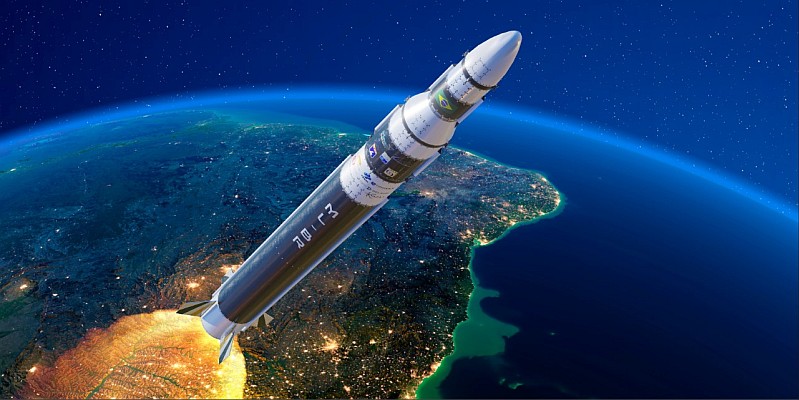
Testing conducted by MLBR confirmed the system's robustness and exceeded the pressures predicted for operation.
O desenvolvimento do Microlançador Brasileiro (MLBR) conta com o suporte técnico do Centro de Gestão e Estudos Estratégicos (CGEE).
The Brazilian Microlauncher (MLBR), an initiative focused on developing a small launch vehicle to place satellites into orbit from national territory, successfully completed an important first-stage engine endurance test on January 24th. The test represents another step forward in the project's timeline and confirms the safety and robustness of the system.
Known as a hydrostatic test, the test was carried out on a test bench and aimed to simulate the main conditions encountered during a launch, such as the internal pressure in the engine and the mechanical forces acting on the vehicle at the moment of takeoff.
During the procedure, the engine was filled with water and subjected to a gradual increase in pressure, while a piston installed at the base of the equipment replicated the typical loads of flight. This methodology allows for the safe and controlled evaluation of the system's structural behavior before propellant testing is conducted.
The result exceeded the project's expectations. The motor rupture occurred only at 103 bar, a value significantly higher than the maximum pressure predicted for nominal operation, estimated at 67 bar, indicating a wide margin of structural safety.
For Ralph Correa, from Cenic, the company leading the project, the test marks an important step forward in the vehicle's development.
“This test is crucial because it confirms, in practice, that the engine can withstand much more severe conditions than those anticipated for flight. It is a result that demonstrates the maturity of the project and the quality of the work developed by the teams involved,” he states.
The test is part of a series of steps planned for the qualification of the vehicle's systems, which aims to expand Brazil's autonomy in accessing space and meet the growing demand for launches of small satellites.
About MLBR
The MLBR is developed by a production arrangement formed by the companies Cenic, Concert Space, PlasmaHub, Delsis, and Etsys, with the support of strategic partners such as Almeida's, Bizu Space, Fibraforte, and Horuseye Tech. The project is the result of a public call for proposals from the Financing Agency for Studies and Projects (Finep), linked to the Ministry of Science, Technology and Innovation (MCTI), in partnership with the Brazilian Space Agency (AEB), with resources from the National Fund for Scientific and Technological Development (FNDCT) allocated to the Brazilian Space Program.
The initiative also has the technical support of the Center for Management and Strategic Studies (CGEE) and the support of the Brazilian Aerospace Industries Association (AIAB). The first version of the vehicle will be 12 meters high, 1.1 meters in diameter, and will be equipped with three solid propellant engines. The payload capacity to be placed in an orbit at an altitude of 450 km at an inclination of 25 degrees is approximately 40 kg, thus meeting a growing global market demand for launches of small satellites with commercial applications in areas such as telecommunications, agriculture, environment, data, security, location, and monitoring.
Source: with information and images from Cenic.
Related news
The 5th "Space in Focus" webinar addresses satellite navigation (PNT) and national sovereignty.
4 of May, 2026The webinar featured the participation of experts and promoted discussion on strengthening national capabilities in National Technology and its impacts on areas such as defense, infrastructure, logistics, and innovation.
CGEE participates in GSI webinar on challenges of the National Transportation Plan in Brazil.
23 of April, 2026The webinar will feature expert participation and promote discussion on strengthening national capabilities in National Technology Planning (NTP) and its impacts on areas such as defense, infrastructure, logistics, and innovation.
How does a Brazilian satellite reach orbit? Science explains.
15 of April, 2026Learn about the steps from defining a satellite's mission, through its construction, until it reaches space.