Brazil and critical minerals after the new framework.
5 of October, 2026
Share:
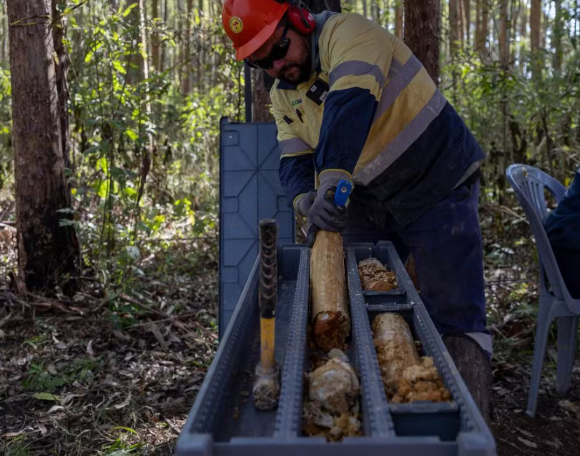
Only regulation will determine whether a country will transform mineral wealth into technology and sovereignty.
Foto: Victor Moriyama/Bloomberg
Brazil has just taken an important step in a dispute that is no longer just about minerals. Congress approved the National Policy on Critical and Strategic Minerals, and the text was signed into law by the Presidency of the Republic. The new framework creates financing, incentives for mineral processing, investments in research and development, and control mechanisms over strategic assets. It's progress. But the most important question arises precisely after the law's approval: what does Brazil intend to do with its critical minerals?
Owning mineral deposits does not mean controlling a value chain. Between the extracted ore and a high-tech product, there are beneficiation, separation, refining, metallurgy, and component materials. It is in these stages that knowledge, skilled jobs, income, and technological power are concentrated.
Rare earth elements are a prime example. The challenge is not only extracting them, but mastering their separation and refining, and advancing to high-purity oxides of metals, alloys, and permanent magnets used in electric motors, wind power generation, electronics, and defense. A country can possess large reserves and still remain technologically dependent.
In a statement released at the end of August, the Brazilian Academy of Sciences and the Brazilian Society for the Advancement of Science warned that the central issue regarding rare earth elements should not be the nationality of the investor, but rather the development project associated with the exploitation of these resources. This means that it is not enough to extract them in Brazil – "it is necessary to develop knowledge, processing and refining technologies, higher value-added products, industrial capabilities and qualified jobs in the country," the organizations pointed out.
This issue also guided the study 'Rare Earths in Brazil: State of the Art, Scenarios and a Strategic Roadmap for 2026-2040', published by the Center for Management and Strategic Studies (CGEE). The research sought to identify which industrial and technological capabilities need to be built so that a larger share of the value remains in the country. The conclusion can be summarized in one sentence: Brazil should not compete only for minerals; it needs to compete for added value.
It is interesting that the legislative process, through its own path, has arrived at a similar direction. The approved policy encourages processing and transformation within the national territory, allows prioritization of projects according to their contribution to value addition, and permits commitments associated with exports and the internalization of stages of the supply chain. It also provides guarantees, tax incentives, and investments in research, development, and innovation.
But it doesn't eliminate a real risk: Brazil could, despite the new law, remain among the first links in global supply chains. That's precisely why regulation will be crucial.
The law establishes an architecture. Now it will be necessary to choose which minerals and supply chains will have priority, which projects deserve incentives, what value-added commitments will be required, and how the strategic control mechanisms will work. Some of these definitions have been left to regulation.
While large mining companies considered the text of the law a possible consensus, smaller companies and mineral exploration companies expressed concern about issues involving legal certainty, the powers of the new National Council for the Industrialization of Critical and Strategic Minerals, and the effects on the entry of foreign capital. For companies dependent on successive rounds of financing, changes in the perception of regulatory risk have immediate effects. This tension should not be treated as a choice between sovereignty and investment. Sovereignty and legal certainty must go hand in hand.
The State must preserve the capacity to protect truly strategic assets, technologies, and supply chains. But this intervention needs to occur with objective criteria, transparency, predictability, and well-founded decisions. A policy that indiscriminately drives away capital and technology can hinder the very projects it intends to stimulate. A policy without reciprocal benefits, on the other hand, can finance a new round of resource exports with little transformation in the country.
There is no single solution for all critical minerals. The idea of "adding value" has different meanings for rare earths, lithium, graphite, or niobium. Therefore, a national policy should be horizontal in its principles but differentiated in its implementation.
The CGEE study on rare earths offers a methodology: diagnose each chain, locate bottlenecks, identify critical capabilities, establish goals, and build a roadmap. For rare earths, this means prioritizing separation and refining and moving towards metals, alloys, magnets, and advanced materials. For other minerals, the path will be different.
We also need to broaden the meaning of value creation. It's not enough to move up the industrial chain if the benefits don't reach the territories. Technological development, human resource training, skilled jobs, national suppliers, environmental sustainability, and dialogue with communities must all be part of the same equation.
Brazil possesses significant mineral resources, established scientific institutions, industrial expertise, and the capacity to build relationships with diverse economic centers. Simultaneously, energy transition and geopolitical tensions are reorganizing supply chains. Rarely have we had such a clear window of opportunity to transform geological advantages into industrial and technological ones.
But it's important to remember that a law doesn't build a separation plant. It doesn't train engineers. It doesn't produce technology. It doesn't create suppliers. It doesn't transform scientific knowledge into an industrial scale. It can, however, create the conditions for that to happen.
Congress answered the first question: Does Brazil need a policy for its critical and strategic minerals? The answer was yes. Now comes the more difficult question: what capabilities do we want to build from this policy?
This article was originally published by the CEO of CGEE, Anderson Gomes, in Valor Econômico.
Related news
To avoid becoming dependent on GPS.
13 of October, 2026In an article published in O Globo, the CEO of CGEE, Anderson Gomes, articulates the importance of mastering the Positioning, Navigation and Time (PNT) system, which enables telecommunications services, financial systems, precision agriculture, air transport, logistics and energy.
Rare professionals: industrialization alone is not enough; the country needs workers who can transform minerals into technology.
14 of September, 2026In an article published in CartaCapital, the CEO of the Center for Management and Strategic Studies (CGEE), Anderson Gomes, discusses one of the bottlenecks for Brazil's progress in this area: the training of specialized human resources.
From uranium to niobium, lessons for Brazil regarding rare earth elements.
31 of August, 2026Despite its substantial resources, the country lacks an ecosystem that connects universities, government, and financial institutions. The challenge is to build a framework that stimulates mineral production and encourages the internalization of technological capabilities.