The President of CGEE participates in a panel discussion on sustainable ecosystems in education.
19 of October, 2026
Share:
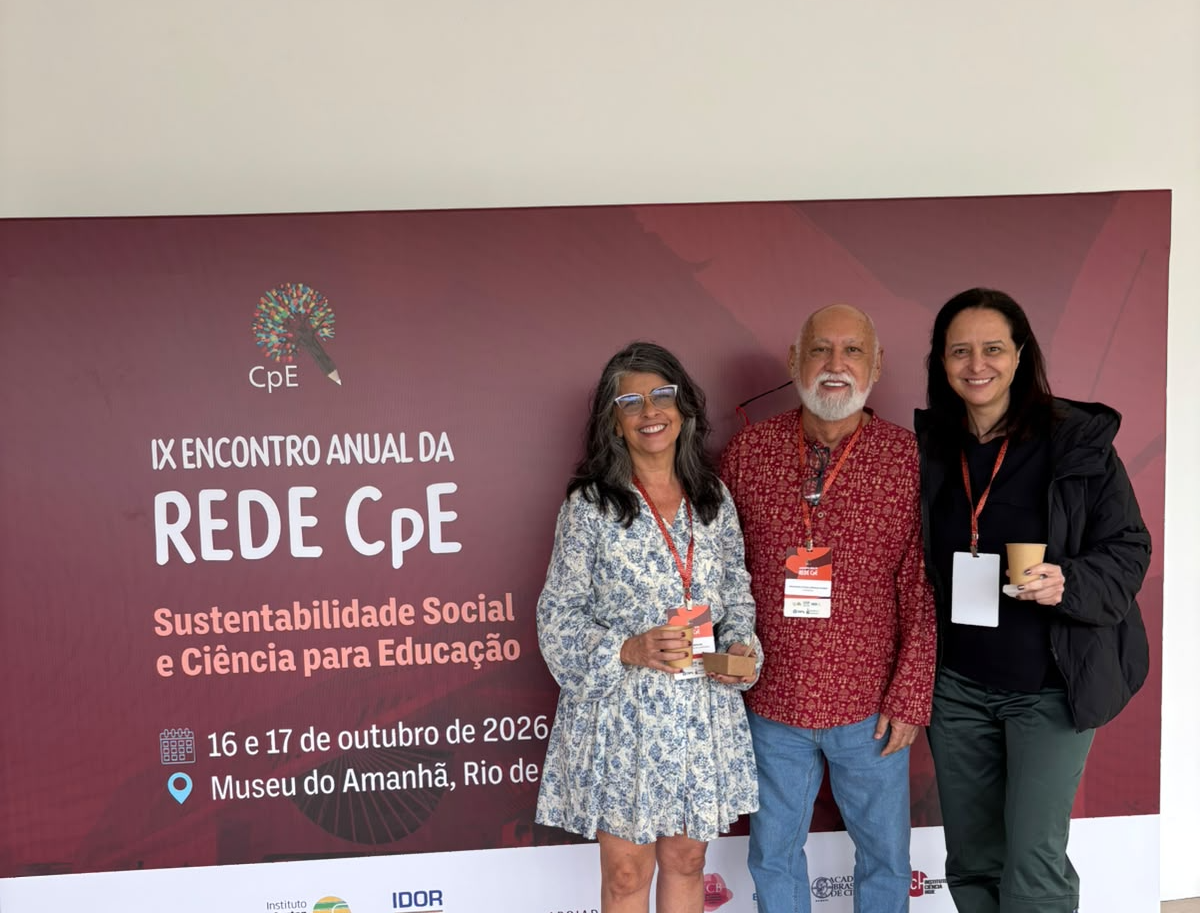
At the 9th Annual Meeting of the CpE Network, Anderson Gomes addressed the connection between science, institutions, and funding for the continuity of educational initiatives.
The CEO of the Center for Management and Strategic Studies (CGEE), Anderson Gomes, highlighted the factors that contribute to the continuity and expansion of the results of educational initiatives during the panel “Promoting Sustainable Ecosystems in Education,” at the IX Annual Meeting of the Science for Education Network (CpE). His approach emphasized the integration between financial resources, personnel training, institutional governance, collaborative networks, and scientific evidence.
Held on October 16th and 17th at the Museum of Tomorrow in Rio de Janeiro, the meeting's theme was "Social Sustainability and Science for Education." The program brought together researchers, teachers, and students to discuss the contributions of science-based education to well-being, inclusion, and the reduction of social inequalities.
Professor Anderson, from the Physics Department at the Federal University of Pernambuco (UFPE) and regional vice-president of the Brazilian Academy of Sciences (ABC) for the Northeast and Espírito Santo, was part of the panel alongside Tatiana Leite, co-founder of the Benfeitoria Group, and Marina Peixoto, founding partner of MP Consultoria. The moderator was Renata Aranha, affiliated with UERJ, IDOR, and the CpE Network.
In his presentation, Anderson addressed the challenges of incorporating project results into the structures and practices of educational institutions. He emphasized that the continuity of initiatives depends on mechanisms that preserve the teams, the accumulated knowledge, and the ability to apply the lessons learned in other contexts.
"Sustainability begins when knowledge ceases to belong to the project and becomes part of the capacity of the institutions," he emphasized.
The analysis brought together five essential elements of capital for the sustainability of an educational ecosystem: financial, human, institutional, social, and scientific. Beyond the resources and skills of the teams, the approach highlighted the importance of stable rules, trust among partners, and the production of evidence to evaluate results and guide long-term decisions.
Anderson also addressed the role of the State in financing, in coordinating between actors, and in creating conditions for the continuity of actions. For the five-year horizon of the CpE Network, he presented proposals for strengthening governance, bridging the gap between scientific production and the needs of educational systems, monitoring results, and diversifying sources of support.
Strategic information for education and sustainability.
According to Anderson Gomes, this approach aligns with CGEE's work in producing prospective studies and strategic information to support public policies. Through its observatories, the Center monitors trends and gathers evidence to support planning and decision-making.
In the area of sustainability, the Innovation Observatory for Sustainable Cities (OICS) identifies and systematizes solutions to urban challenges, including nature-based solutions. Its studies, publications, and experience databases provide input for policy formulation and planning at the municipal, state, and federal levels, bridging the gap between knowledge and the needs of the territories.
At the interface between education and scientific development, the Observatory of Human Resources for Science, Technology and Innovation (ORHCTI) monitors the training and employment of qualified professionals in Brazil, with a focus on masters and doctoral degree holders. The analyses contribute to understanding the country's skills base and support public policies for education and science, technology and innovation.
The Science, Technology and Innovation Observatory (OCTI), in turn, monitors national and international scientific production, situating Brazilian participation within the global context. Its analyses allow for tracking trends and identifying scientific competencies, providing support for planning actions in Science, Technology and Innovation.
At the end of the presentation, Anderson invited the participants to explore the observatories and studies available on the CGEE website and offered the institution's support for initiatives that bring science, education, and sustainability closer together.