Seminar of the Green Transition in Industry program discusses pathways to a sustainable economy.
29 of April, 2026
Share:
Ascom/CGEE
Meeting brings together experts to discuss financing, international experiences, and strategies for fair industrial decarbonization in Brazil.
The Center for Management and Strategic Studies (CGEE) held today (29) the seminar of the Green Transition in Industry (TVI) program, bringing together experts, representatives of financial institutions and public policy makers to discuss strategies and instruments aimed at promoting a more sustainable economy in Brazil. The program presented the preliminary results of the research being conducted within the scope of TVI and was held at the headquarters of the Financing Agency for Studies and Projects (Finep), in Rio de Janeiro (RJ).
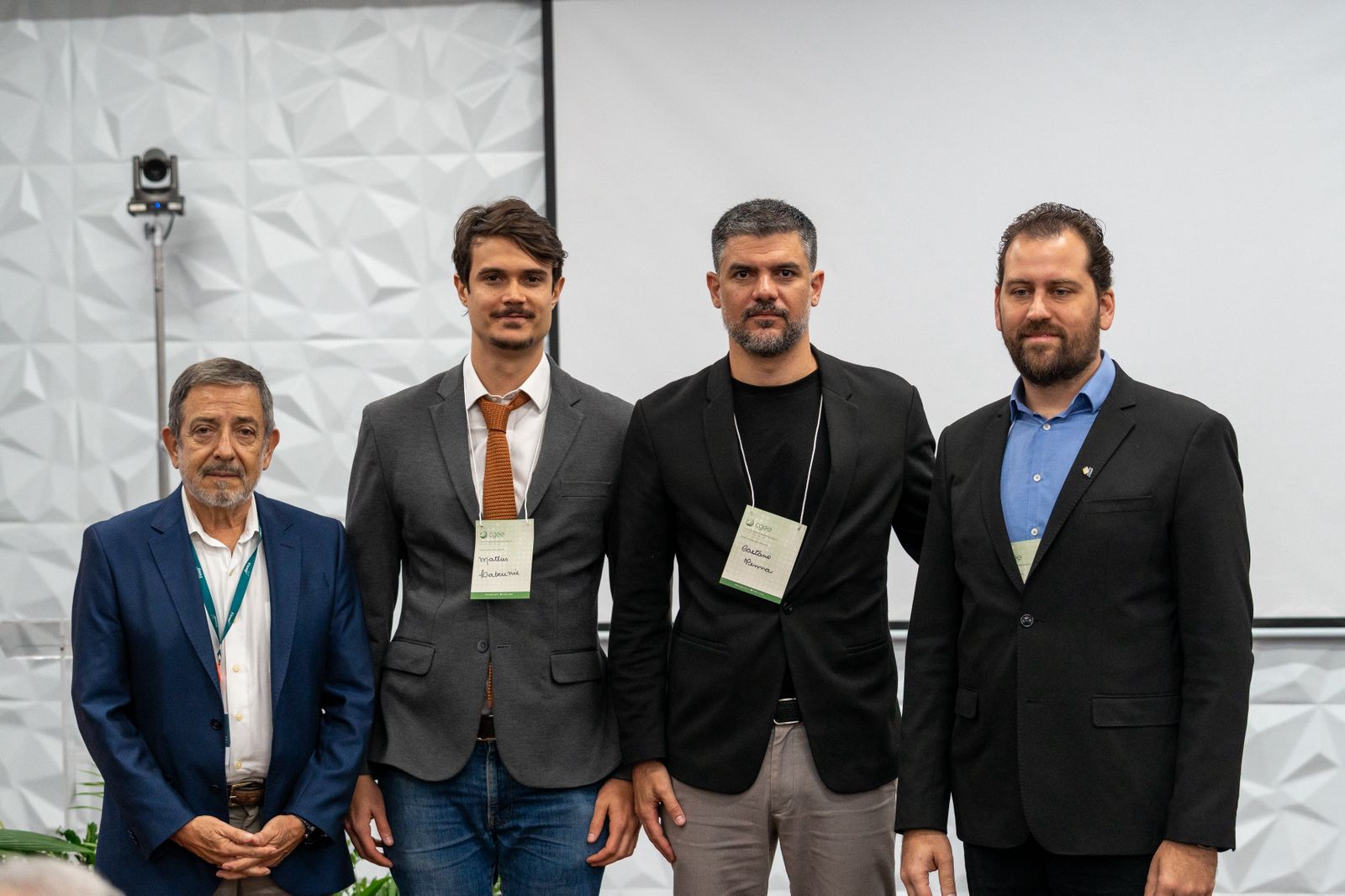
The institutional opening was conducted by the Director of Strategic Projects and International Relations at CGEE, Caetano Penna; the advisor to the president of Finep, economist Mariano Laplane; the president of the Brazilian Development Association (ABDE), Eduardo Djanikian; and the representative of the Cambridge Industrial Innovation Policy (CIIP), Mateus Labrunie.
During the opening, Laplane highlighted the relevance of the topic for the country and the role of the industrial sector in this process. “Industry is an important protagonist in the green transition, both as a producer and developer of solutions, but also as a user of these innovations,” he stated. The economist also emphasized Finep's role in supporting the innovation agenda in Brazil. “It is an important topic for the whole world, and particularly for Brazil. We received this initiative at an opportune moment and with the expectation of seeing significant results for the advancement of this agenda,” he said.
Caetano Penna, in turn, highlighted the collaborative construction of the project and its international articulation. “This work stems from the dialogue between CGEE, ABDE, and Cambridge, based on a common agenda regarding the role of development financing institutions in the green transition of industry,” he stated. The director also explained the structure of the study. “We are developing two tracks: one focused on financing instruments, from the supply side, and another dedicated to mapping the production chains with the greatest potential in the Brazilian bioeconomy,” he said. Penna also emphasized the next steps of the initiative. “The consolidated results will be presented at an event scheduled for June,” he noted.
The president of ABDE, Eduardo Djanikian, emphasized the relevance of the study for the national development finance system. “This research is fundamental for development finance institutions, which play a central role in financing the green transition, the bioeconomy, and industry in Brazil,” he stated. According to him, the seminar also serves to enhance the debate. “This is an important moment to present preliminary results and, at the same time, gather contributions that can improve the study,” he said. Djanikian also highlighted the continuity of the work. “The final results will be presented in June, at an event in Espírito Santo, in partnership with Bandes,” he added.
Representing the Cambridge Industrial Innovation Policy (CIIP), Mateus Labrunie highlighted the origin of the partnership and the collaborative nature of the initiative. “The idea for the project arose from dialogues with different institutions in Brazil and took shape in partnership with ABDE and CGEE, each contributing with their expertise,” he stated. According to him, the division of efforts was central to the advancement of the study. “Cambridge contributes with the international analysis, while CGEE brings the Brazilian perspective and ABDE mobilizes its associated institutions,” he explained.
Labrunie also highlighted the role of institutional support in expanding the scope of the project. "There was an incentive for the initiative to be more ambitious, which allowed us to expand the study and deepen the analyses that we are now presenting in a preliminary form," he said.
Schedule
In the first session, preliminary results of the research conducted by CIIP within the framework of TVI were presented, with an analysis of the global scenario of the green industrial transition. The study addresses challenges, financing instruments, and international experiences relevant to the Brazilian context, and its consolidated results will be released in June. The presentation was led by Mateus Labrunie and Francisco Pereira, followed by a debate with the participants. The initiative is conducted by CGEE, in partnership with CIIP and ABDE, with the support of the Open Society Foundations (OSF).
Following that, the second session discussed the role of public banks in promoting biofuels. Moderated by Caroline Pereira, project leader of TVI at CGEE, the panel offered reflections on the trajectory of bioethanol financing in Brazil, with contributions from Caetano Penna and Professor Luiz Augusto Horta Nogueira from the Federal University of Itajubá. Comments were provided by the leader of the Bioeconomy Observatory at CGEE, Marcelo Poppe, followed by a discussion with the audience.
In the afternoon, the third session addressed the role of Brazilian development finance institutions (DFIs) in subnational strategies for the green transition. Moderated by the president of ABDE, Eduardo Djanikian, the session brought together representatives from member institutions to present concrete experiences in financing the green industrial transition, highlighting instruments, programs, and challenges faced. Participants included Patrick Gomes, from the Espírito Santo Development Bank (Bandes), and André Santanna, representing the National Bank for Economic and Social Development (BNDES). A discussion followed, with a presentation by a representative from the Southern Regional Development Bank (BRDE).
Next, the roundtable discussion “How to Promote Fair Industrial Decarbonization?” brought together different perspectives on ways to align economic growth, sustainability, and inclusion. The discussion was moderated by Caetano Penna (CGEE), with participation from representatives of the National Bank for Economic and Social Development (BNDES), André Santanna, as well as João Abbud (E+), Mateus Labrunie (Cambridge CIIP), and Henrique Vasquez (Finep).
The closing session included a summary of the main points discussed throughout the seminar and an indication of the program's next steps, with speeches by director Caetano Penna, Eduardo Djanikian, and Mateus Labrunie.