CGEE joins the Innovation Working Group for the Mineral Sector.
13 of May, 2026
Share:
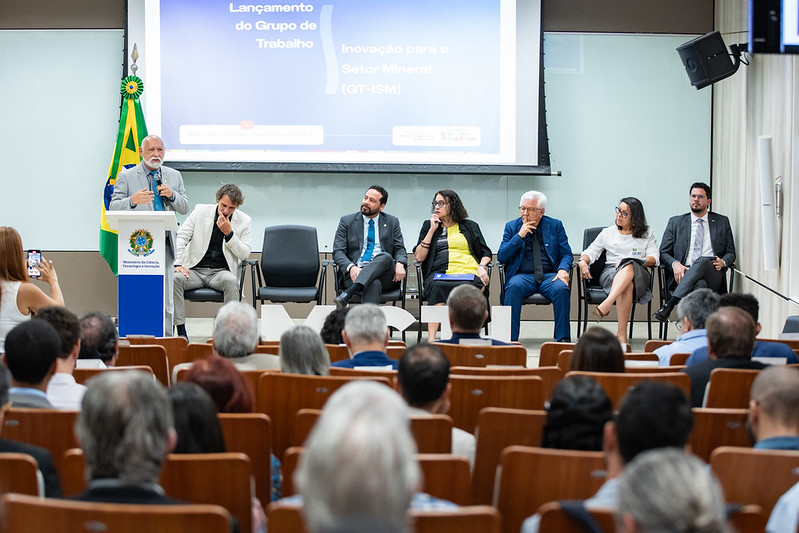
Rodrigo Cabral (Ascom/MCTI)
During launch at MCTI, Center announces updated strategic study on rare earths.
The Ministry of Science, Technology and Innovation (MCTI) held, this Tuesday (13), at the ministry's headquarters, the launch ceremony of the Innovation Working Group for the Mineral Sector (GT-ISM) – National Technological Sovereignty. The initiative aims to structure and propose policies aimed at strengthening innovation in the Brazilian mineral sector, contributing to sustainable development and the country's insertion into global value chains.
The opening panel included the participation of the Minister of Science, Technology and Innovation, Luciana Santos; the Secretary of Technological Development and Innovation of the MCTI, Daniel Almeida; the president of the National Council for Scientific and Technological Development (CNPq), Olival Freire; the CEO of CGEE, Anderson Gomes; the Director of Innovation and Institutional Relations of Embrapii, Igor Nazaré, representing CEO Álvaro Prata; and the acting superintendent of the Energy Transition and Infrastructure area of Finep, Henrique Vasques.
During the ceremony, the CEO of CGEE, Anderson Gomes, participated in the opening panel and highlighted the strategic importance of the mineral sector for the country's development and national technological sovereignty.
Following this, Anderson Gomes gave a presentation in which he highlighted the role of rare earths as strategic minerals for the energy transition and the high-tech industry. The CEO of CGEE also announced an update to the Center's study on rare earths, a benchmark in the debate on critical and strategic minerals in Brazil.
According to the director, the updated study on rare earth elements will incorporate new methodologies and a broader understanding of the geopolitical and technological landscape.
“We will update this study, which covers the period from 2012 to 2030, to a new horizon from 2026 to 2040, based on a different methodology, including technological-industrial diagnosis, technological prospecting with in-depth patent analysis, geopolitical monitoring, and scenario building,” he stated.
He highlighted that the update will feature a collaborative and multidisciplinary structure, bringing together experts who participated in the previous edition and new researchers with different perspectives, especially in the areas of strategy and geopolitics.
"The study provides an integrated analysis of value chains and opportunities for Brazil in a context of global disputes over strategic minerals," he said.
Gomes also highlighted that Brazil is strategically positioned to be a leading player in the sector, given the transformations in the global rare earth supply chain and the increased demand for technologies associated with the energy transition and the digital economy.
Established within the scope of the Ministry of Science, Technology and Innovation (MCTI), the Innovation Working Group for the Mineral Sector (GT-ISM) will be coordinated by the ministry's Secretariats for Technological Development and Innovation and brings together representatives from institutions such as Cetem, CGEE, CNPq, Finep and Embrapii, as well as invited members from academia, the productive sector and civil society. The group will focus on formulating proposals to strengthen innovation and technological sovereignty in the Brazilian mineral sector.
Related news
CGEE supports Fulbright–CNPq Mission on Rare Earths and Critical Minerals
21 of October, 2026The initiative involved the participation and collaboration of CGEE and researchers from seven Brazilian institutions.
National policy for critical and strategic minerals is approved by the Federal Senate.
8 of September, 2026The text, which now goes to the president for approval, is addressed in the study "Rare Earths in Brazil: State of the art, scenarios and a strategic roadmap for 2026-2040," by CGEE.
CGEE promove debate sobre o papel do Brasil nas cadeias globais de terras raras durante a SBPC 2026
28 of July, 2026Agenda destacou oportunidades e desafios para agregar valor às terras raras no Brasil.