CGEE Director participates in the launch of the Science, Technology and Innovation Agenda for the Pantanal.
3 of February, 2026
Share:
In addition to outlining the institute's goals up to 2030, the project reaffirms the importance of valuing traditional knowledge and water security in the region.
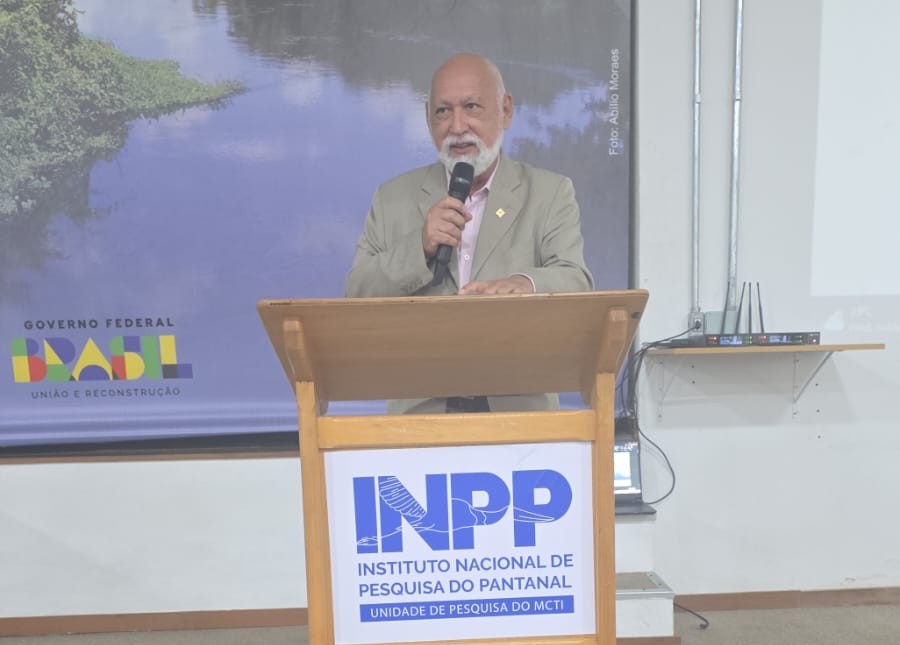
Diretor do CGEE, Anderson Gomes, durante o lançamento da Agenda de Ciência, Tecnologia e Inovação para o Pantanal
The director of the Center for Management and Strategic Studies (CGEE), Anderson Gomes, was present at the launch of the Science, Technology and Innovation Agenda for the Pantanal, held this Monday (2), at the headquarters of the National Institute for Pantanal Research (INPP), in Cuiabá (MT). The occasion also celebrated World Wetlands Day, inviting appreciation of the cultural heritage and knowledge of traditional communities.
The event brought together representatives from educational and research institutions, state secretariats, funding agencies, as well as guests directly involved with the Pantanal agenda, reinforcing the importance of integrating science, traditional knowledge, and public policies for the protection of these ecosystems that are strategic for biodiversity, climate, and human well-being.
During the ceremony, the head of CGEE highlighted the importance of transforming planning into action, focusing on people and education from the earliest years, to guarantee real and lasting impact. "This science, technology, and innovation agenda for the Pantanal is a cross-cutting agenda, which begins with the people and must end with the people [...] So, we have to take it off the paper, which is very well organized, very well planned."
The director also reminded everyone that this year, CGEE celebrates 25 years of operation, carrying out studies that reinforce national strategic planning. “When we create a strategy, if it's not ambitious, it's worthless. Be ambitious, but keep your feet on the ground, because you have the capacity and the resources,” he stated.
The project
Developed throughout 2025 based on meetings and dialogues with different stakeholders involved in the Pantanal biome, the document addresses topics ranging from biodiversity preservation and sustainable regional development, with planning extending to 2035. The agenda also promotes the consolidation of broader, more representative, effective, and participatory environmental governance regimes, as well as the improvement of integrated and efficient management of natural resources, for the benefit of conservation and local income generation.
The guide was built collectively and in a pluralistic way, bringing together academia, government, the productive sector, and civil society to promote the sustainable development of the world's largest continuous wetland. The INPP's research coordinator between 2022 and 2025, Professor Marinêz Isaac Marques, detailed the institute's structuring trajectory and the development of the Science, Technology, and Innovation Agenda for the Pantanal.
The first document created was the Unit Master Plan (PDU), for the period 2025 to 2030, with the mission of contributing to the establishment of a sustainable society in the Pantanal and other wetlands of Brazil. In her speech about the launch of the agenda, Marinêz emphasizes that one of the highlights was the articulation of the project around the need to mitigate environmental disasters, such as recurring fires, seeking data-driven solutions.
“What can be done to mitigate these risks, these environmental disasters, so that they don't become frequent and recurring? This agenda was mainly motivated by these questions. We selected strategic themes: the preservation of biodiversity and regional development, and we used the quadruple helix model of innovation, which allows academia to connect with government, the productive sector, and society. There were approximately 400 strategic actors located in this region who work in the Pantanal. We delivered this quite robust document to initiate the activities of the INPP, with 185 pages of documentation, questions, conclusions, inquiries, and reflections,” he said.
The quad helix model of innovation is a collaborative framework that brings together civil society with the three traditional actors of the triple helix: university, industry, and government. It focuses on co-production, user-centered innovation, and sustainability, where knowledge is applied to solve real societal problems.
Wetlands
The Rector of the State University of Mato Grosso (Unemat), Vera Lúcia Maquea, representing the state's higher education institutions, emphasized the cooperation between different actors for the development of areas that encompass the biome.
"The gathering of all these actors is fundamental for us to succeed in this agenda. I would also like to point out that the plan includes other wetlands, which I think is very important. We have other similar biomes in the country that also need to incorporate this research," he stated.
Related news
After years of decline, public investment in science and technology advances 30% in the country.
18 of June, 2026A study released this Tuesday (16) shows that Brazil interrupted the downward trajectory of resource transfers and resumed funding for research.
Public perception of science is key to Brazil's development.
11 of May, 2026This video highlights the role of science, technology, and innovation in everyday life and in building the future. Access the link in the article!
National Meeting on the Popularization of Science initiates debates on public perception and strengthening policies for the sector.
4 of December, 2025On the first day of the event, on Tuesday (2), experts highlighted the challenges the country faces in expanding investments and assessed Pop Ciência. The program continues until Thursday (4).