Free Conference marks CGEE's 25th anniversary with a debate on science, innovation and sustainable development in the 2030 Agenda.
20 of May, 2026
Share:
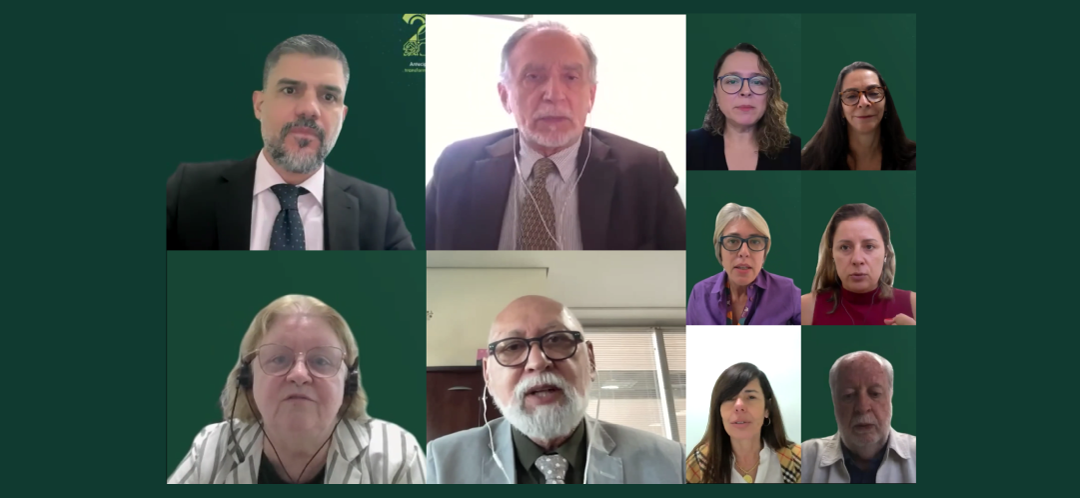
The program reinforces CGEE's role in formulating and building public policies aligned with the Sustainable Development Goals.
The Free Conference “CGEE 25 years: trajectories of Brazilian S&T in the light of the Sustainable Development Goals (SDGs)” brought together, today (20), the board, collaborators of the Center for Management and Strategic Studies (CGEE), as well as guests from the academic community in a debate on the role of science, technology and innovation in the formulation of public policies and in the sustainable development of the country. The meeting was part of the celebrations of the organization's 25th anniversary and the preparatory process for the 1st National Conference on Sustainable Development Goals.
In his opening remarks, the institution's CEO, Anderson Gomes, highlighted the central role of the Sustainable Development Goals in the Center's work. "When we revisit these actions, we can identify what we were already doing and how it fits into the 17 SDGs. Since 2015, everything we do has been approached with this perspective," he stated.
The organization's Director of Strategic Projects and International Relations, Caetano Penna, highlighted the Center's role as one of the main spaces for translation between the global development agenda and the national policy on science, technology, and innovation. According to him, the institution has been working for 25 years to build connections that allow dialogue between different scales and actors, especially in a context where S&T incorporates geopolitical dimensions, long-term financing, and socio-technical transitions.
“The Sustainable Development Goals are, first and foremost, a shared conceptual framework. They function as a common vocabulary that allows science, technology, and innovation policy formulated in Brazil to engage with international agendas for development, financing, and cooperation,” he stated.
He cited as an example a study developed in partnership with the European Commission's Joint Research Centre, which mapped funding flows for science, technology and innovation destined for sub-Saharan Africa. According to him, the work highlighted not only the challenges of resource volume, but above all issues of traceability, alignment and directionality of investments, in addition to generating a methodology applicable to other analyses conducted by the Centre. "This is the space for translation that the organization has built over the past 25 years," he said.
The Center's Director of Administration and Finance, Geraldo Nunes, highlighted the institution's cross-cutting nature in linking knowledge and public policies, and reinforced that CGEE is a suitable space for debates on science, technology, and innovation. "Due to its cross-cutting nature, the Center is the appropriate place to address issues related to linking knowledge to public policies," he stated.
The organization's Director of Strategic Projects and Institutional Relations, Connie McMannus, emphasized that the SDGs represent a central question about the future that society aspires to. "The SDGs raise a very simple and powerful question: what kind of country and world do we want to build?" she said. She added that, over these 25 years, the Center has helped to articulate connections between science, government, academia, innovation, and development, especially between knowledge and decision-making.
CGEE and the SDGs
The program was structured into three thematic blocks, which addressed topics ranging from the formation and institutional consolidation of the Center to agendas for expansion, territorialization, and inclusion in science, technology, and innovation policies, as well as discussions on emerging technologies, technological sovereignty, and sustainability.
In the second segment, participants included the coordinator of the organization's Science, Technology and Innovation Observatory (Octi), Adriana Badaró; the leader of the Human Resources for Science, Technology and Innovation Observatory (ORHCT&I), Sofia Daher; and project leader Dulcilene Xavier, with presentations on territorial planning, capacity building in Science, Technology and Innovation, and experiences of integration between education and the productive sector.
In the third segment, the leader of the Digital Technologies Observatory (OTD), Caroline Nascimento, detailed the initiative developed by the Center aimed at systematizing and analyzing data and trends in digital transformation, supporting studies and public policies in the field of science, technology, and innovation.
Following this, the project leader and advisor to the president of the Center, Kilma Gonçalves Cezar, presented the "Politics with Science" initiative, highlighting the importance of evidence production for the formulation of public policies and reinforcing the cross-cutting nature of the SDGs in the National Strategy for Science, Technology and Innovation (ENCTI).
The leader of the organization's Positive Agenda for Climate Change and Sustainable Development, Marcelo Poppe, highlighted the Center's agendas on economy, climate and territorial development, with a focus on bioeconomy and sustainable transitions.
Next, the panel featured the participation of the institution's CEO, Anderson Gomes, who presented the National Strategy for Science, Technology and Innovation (ENCTI), highlighting its structuring character and its alignment with the SDGs. According to him, the strategy establishes long-term planning for the sector, articulating science, technology, industry, territory and society, in addition to proposing the expansion of investments in research and development to 2% of GDP by 2034.
Kilma Gonçalves Cezar, project leader and advisor to the organization's president, added that ENCTI embodies, in an integrated way, the relationship between science, technology, and sustainable development, reinforcing that all Sustainable Development Goals are aligned with the guidelines and recommendations of the national strategy.
Related news
CGEE integra Comissão Organizadora da 1ª Conferência Nacional da Engenharia
2 of October, 2026Iniciativa reúne governo, instituições de ensino e pesquisa e representantes do setor produtivo para discutir os desafios da engenharia e sua contribuição para o desenvolvimento sustentável e tecnológico do país
CGEE supports MIT ANPEI Brazil Summit 2026 on innovation and competitiveness.
22 of September, 2026The event, which will take place on October 8th in São Paulo, will bring together leaders, experts, companies, and institutions to discuss strategies for cooperation, open innovation, and resilience in the face of the transformations of the global landscape.
CGEE holds a technical-scientific event about its history and contributions to science, technology, and innovation.
3 of September, 2026A special session, on September 21st, will bring together leaders from the science, technology, and innovation ecosystem to reflect on the role of science in formulating public policies and making strategic decisions for the country.