Brazilian bioeconomy depends on inclusive science and a regulatory framework, experts argue at COP30.
24 of November, 2025
Share:
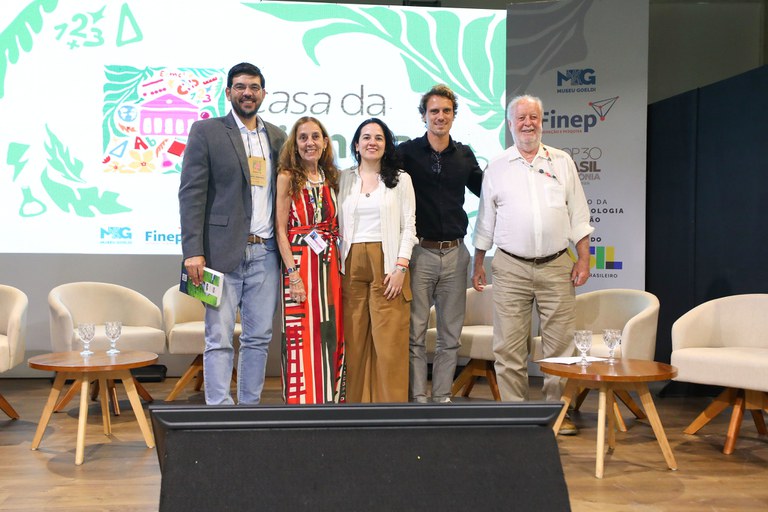
Researchers highlighted the potential of captive biomass for neo-industrialization and the need to include traditional knowledge in the National System of Science, Technology and Innovation.
The Brazilian bioeconomy goes beyond a mere productive sector; it is a development model capable of driving neo-industrialization and the ecological transformation of the country. This was the main conclusion of the second round table on Tuesday (18), at the House of Science, during the 30th United Nations Conference on Climate Change (COP30). The event brought together leaders and experts from the Ministry of Science, Technology and Innovation (MCTI), the Ministry of Environment and Climate Change (MMA), the Financing Agency for Studies and Projects (Finep), the National Research Center in Energy and Materials (CNPEM) and the Center for Management and Strategic Studies (CGEE).
The debate highlighted Brazil's strategic role in overcoming the global challenges of oil dependence and climate change. According to the scientists, neo-industrialization and ecological transformation must be supported by the integration of scientific and traditional knowledge and by a regulatory framework that recognizes national unique characteristics.
The director of the National Laboratory of Biofuels at CNPEM, a social organization linked to the MCTI (Ministry of Science, Technology and Innovation), Mário Murakami, highlighted Brazil's comparative advantages, describing the country as the "gifted nation of bioeconomy." The researcher emphasized that, faced with a scenario of accelerated global warming and the finite nature of oil reserves, Brazil has unique elements to lead the global energy transition.
"Brazil possesses biomass that does not compete with food [more than half a billion tons of lignocellulosic biomass], renewable energy [90% of the energy matrix], and 100 million hectares of degraded pastures that represent an opportunity for the expansion of bioenergy with a negative environmental impact," explained Murakami. He highlighted the captive biomass—available to industry, ready to be biotransformed—with approximately 200 million tons of waste, which offers a competitive advantage by reducing the final cost of products by two to three times.
According to the expert, CNPEM, as an arm of MCTI, has concentrated its efforts on guaranteeing national technological sovereignty through the co-development of biotechnology. Murakami cited the discovery of a new bacterial phylum—one of the main and most comprehensive taxonomic categories used to classify bacteria—in sugarcane bagasse which, after being integrated into the MCTI platform, optimized the industrial application of biocatalysts—molecules or biological systems (such as enzymes or whole cells) that have the ability to accelerate (catalyze) specific chemical reactions—by more than 20%.
The National Bioeconomy Development Plan
The Bioeconomy Coordinator at the Ministry of the Environment (MMA), William Saab, detailed the structuring of the National Bioeconomy Development Plan (PNDBio). This initiative, which considers the bioeconomy as a model for inclusive and participatory development, articulates four strategic components: socio-bioeconomy, biomass, bioindustry, and terrestrial and aquatic ecosystems.
"The bioeconomy, according to the Ministry of the Environment, is a development model and should be based on solutions that connect with nature, combining ethics, inclusion, traditional knowledge, and science," Saab stated.
The plan seeks, among other goals, to diversify sources for biofuels, citing the potential of Macaúba, which can produce up to eight times more oil per hectare than soy, boosting the national bioindustry. Implementation of the plan is already underway, with the mapping of 30 socio-bioeconomy territories and the launch of calls for local productive arrangements (APLs), with capital sources secured by organizations such as the Amazon Fund, via the National Bank for Economic and Social Development (BNDES).
The program coordinator of the Center for Management and Strategic Studies (CGEE), Marcelo Poppe, reinforced the role of the social organization linked to the MCTI (Ministry of Science, Technology and Innovation) as an active provider of strategic data for the National Bioeconomy Commission, created to form the PNDBio (National Program for Biodiversity Development), which has a divided participation (34 members) between government and civil society to guide the process of consolidating the Brazilian bioeconomy. Poppe highlighted the relevance of national scientific production, confirming that Brazil is the largest producer of scientific knowledge about the Amazon.
Knowledge integration
The need for integration between traditional knowledge and the National System of Science, Technology and Innovation (SNCT&I) was addressed by Lara Ramos, Public Policy Coordinator at World Transforming Technologies (WTT). WTT, in conjunction with the Ministry of Science, Technology and Innovation (MCTI) and the Ministry of the Environment (MMA), has been working to build bridges between biodiversity leaders and the science, technology and innovation (STI) ecosystem.
"Our challenge is to drive the paradigm shift towards a more inclusive National Science, Technology and Innovation System (SNCT&I), updating legal norms for the formal recognition of traditional knowledge within the framework of science and technology. We need to incorporate the concept of collaborative work within our innovation system," Ramos argued.
She cited practical examples of how science can support grassroots supply chains, from developing a traceability app for the cashew nut processing to analyzing the sanitary safety of water in bioproducts, such as bioplastic made from cashew nut husks.
Regulatory challenges and public procurement
The panel concluded with a discussion on the urgent need for a regulatory framework that recognizes Brazil's unique characteristics, following audience input on the necessity of robust federal legislation for sustainable procurement and bidding processes.
Mário Murakami emphasized the need for multilateral agreements to recognize Brazil's unique characteristics in carbon accounting.
"Brazilian corn ethanol is very different from American ethanol. Here we have crop rotation and three harvests a year, which reduces land use and the carbon footprint. However, accounting models don't consider this, and we are penalized. We need proper valuation in terms of carbon emissions that recognizes Brazil's unique characteristics," said Murakami, arguing that the energy and ecological transition must be functional, optimizing existing infrastructure and production chains.
Source: Ministry of Science, Technology and Innovation
Related news
CGEE supports international climate debate with contributions towards the implementation of the BTIP.
23 of April, 2026The relevance of these contributions was highlighted by Secretary Pedro Ivo Ferraz da Silva, coordinator of Scientific and Technological Affairs at the Climate Department of the Ministry of Foreign Affairs, and the first Brazilian president of the UNFCCC's Executive Committee on Technology (TEC).
CGEE drives the Green Industrial Transition with a focus on financing and bioindustry.
26 of November, 2025TVI project combines science, innovation and funding to strengthen the sustainable bioeconomy.
Results from the 3rd ICID are presented at COP30 in panels at the House of Science.
26 of November, 2025ICID III reinforces debates on drylands and desertification at COP30.