Brazil hosts international meetings on industrial innovation and green transition in Latin America.
27 of April, 2026
Share:
The agenda will also address the balance between technological cooperation and industrial sovereignty, as well as strategies to overcome the so-called "institutional trap" through new governance arrangements and greater coordination between different levels of government.
O link para inscrição do TVI está disponível ao final da matéria! O Babbage Forum ocorre presencialmente na sede da Finep no Rio de Janeiro.
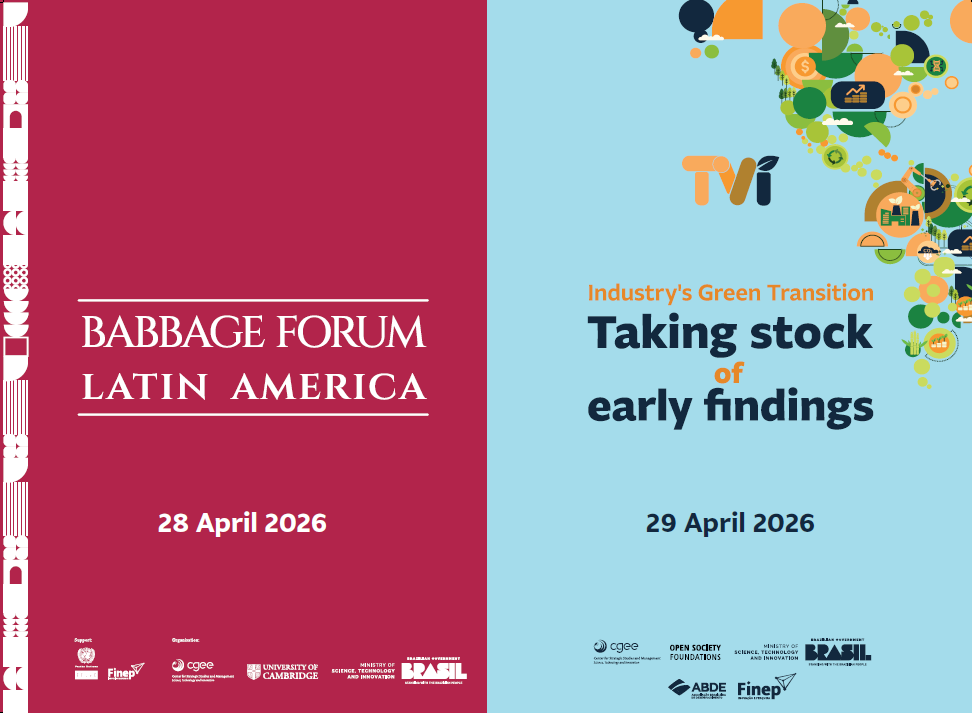
Two international meetings will bring together policymakers, representatives of funding agencies, researchers, and multilateral organizations in Brazil to discuss industrial innovation, productive development, the green transition, and its impacts on the global scenario. On April 28th and 29th, 2026, in Rio de Janeiro (RJ), the first regional meeting of the Babbage Forum in Latin America and the Green Transition in Industry (TVI) Seminar will be held. The initiatives are organized by the Center for Management and Strategic Studies (CGEE), a social organization supervised by the Ministry of Science, Technology and Innovation (MCTI), in partnership with national and international institutions.
On the first day, the regional meeting of the Babbage Forum will take place, an initiative that is part of the Cambridge Industrial Innovation Policy (CIIP), based at the Institute for Manufacturing, a division of the Department of Engineering at the University of Cambridge (United Kingdom). The program will discuss contemporary policies for productive and industrial development, including the New Industry Brazil (NIB), launched by the federal government in January 2024 to boost national industry until 2033. Conceived in conjunction with the New PAC (Growth Acceleration Program), the policy aligns economic, financial and industrial strategies and foresees investments of R$ 300 billion until 2026.
The regional meeting of the Babbage Forum seeks to broaden the exchange of experiences between Latin American countries and international experts, stimulating cooperation and the development of common strategies to address the challenges of the new global economy. This initiative comes at a time when the region faces structural challenges to development, such as low economic dynamism, institutional weaknesses, high levels of social inequality, and stagnant productivity, in addition to the recent decline in investments in science, technology, and innovation.
The debate also includes industrial and production policy initiatives adopted in other countries in the region, such as the Chilean program Desarrollo Productivo Sostenible, the Colombian National Reindustrialization Policy, and similar initiatives in Mexico, Peru, and Uruguay.
The program includes discussions on artificial intelligence applied to industry, international technological collaboration, strengthening institutional capacities, and productive diversification—topics considered central to developing economies seeking to advance in sectors of greater technological complexity.
The agenda will also address the balance between technological cooperation and industrial sovereignty, as well as strategies to overcome the so-called "institutional trap" through new governance arrangements and greater coordination between different levels of government.
The event is organized by the Babbage Forum at the University of Cambridge, in partnership with CGEE, with institutional support from the Financing Agency for Studies and Projects (Finep) and the Economic Commission for Latin America and the Caribbean (ECLAC).
Financing and opportunities for the green transition
Continuing the discussions on productive development policies and industrial innovation initiated on the first day of the event, the Green Transition in Industry (TVI) Seminar will be held on the 29th. The meeting will present preliminary results of an international research project on the role of development finance institutions (DFIs) in financing the ecological transition, bringing together experts from government, academia, and the productive sector.
On this second day, the Open Society Foundations (OSF) is among the supporters.
The study is conducted by CGEE, in partnership with CIIP and the Brazilian Development Association (ABDE), with support from OSF.
Among the topics on the program are the global landscape of green financing strategies, the trajectory of Brazilian financial institutions — from Proálcool to the current initiatives of BNDES and Finep — and the opportunities of the bioeconomy and green industries for Brazil.
The meeting is expected to bring together high-level representatives from ministries, development agencies, and multilateral organizations from countries such as Brazil, Chile, Colombia, Mexico, Peru, and Uruguay, as well as institutions like ECLAC and the Inter-American Development Bank (IDB).
According to the organizers, the event represents a strategic opportunity to deepen the dialogue between industrial policies, development financing, and the green transition, positioning Brazil and Latin America at the center of the global debate on innovation, sustainable development, and economic competitiveness.
The meetings will be held in person at Finep's headquarters in Rio de Janeiro.
Register for the event on the 29th: https://www.sympla.com.br/evento/industry-s-green-transition-taking-stock-of-early-findings/3348415
Related news
Presidente do CGEE debate estratégias para fortalecer a capacidade nacional de resposta a emergências biológicas no Rio Innovation Week
4 of August, 2026Painel reunirá especialistas para discutir como ciência, tecnologia e inovação podem fortalecer a biossegurança, a bioproteção e a soberania tecnológica do país.
The initial milestone of the Innovation Diplomacy Project defines five strategic areas of action.
2 of June, 2026An initiative led by CGEE and MRE will produce evidence, indicators, and diagnoses to support Brazil's international performance in priority technological areas.
MCTI launches working group to transform mineral wealth into technology, industry, and sustainable development.
14 of May, 2026New MCTI group will propose actions to expand technological and industrial content in Brazilian mineral supply chains.