CGEE supports Fulbright–CNPq Mission on Rare Earths and Critical Minerals
21 of October, 2026
Share:
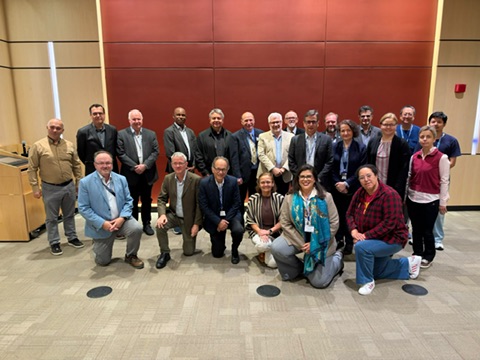
The initiative involved the participation and collaboration of CGEE and researchers from seven Brazilian institutions.
In September 2026, the Fulbright–CNPq Mission on Rare Earths and Critical Minerals brought together Brazilian researchers and representatives to learn about applied research experiences at three research institutes in the United States and to identify opportunities for cooperation. In addition to the participation of researchers from seven Brazilian institutions, the initiative included the presence and collaboration of CGEE, through its Rare Earths project.
The program included visits to Virginia Tech in Blacksburg, the Colorado School of Mines in Golden, the Ames National Laboratory in Iowa, and the US Critical Minerals Symposium. The Center is part of the mission through the Fulbright Commission in Brazil, along with CNPq, and was represented during the visits by the leader of the Rare Earths project, Cesar Costa. The initiative opened opportunities for cooperation and reinforced the importance of funding for applied research in Brazil.
The visit opened up opportunities for collaboration, mainly with the Ames National Laboratory, especially in the area of refining and manufacturing rare earth magnets. “The mission was very productive. It demystified some aspects regarding the recycling of materials: it's not that easy. There are several intermediate processes that are not taken into account and need to be mastered before they become economically viable in this production chain,” highlights Cesar Costa.
Representatives from the University of São Paulo (USP), the State University of Campinas (Unicamp), the Federal University of Sergipe (UFS), the Federal Institute of Education, Science and Technology of Amazonas (Ifam), the Center for Nuclear Technology Development / National Nuclear Energy Commission (CDTN/CNEN), the Ilum School of Science / National Center for Research in Energy and Materials (Ilum/CNPEM), and the Hercílio Randon Institute also participated. At Virginia Tech, the delegation visited mineral processing laboratories and Aclara's rare earth separation pilot plant. The Virginia Tech facility has a qualified team, good organization, and separation circuits in experimental operation, currently fed with synthetic materials prepared to represent the carbonates planned for the future mineral operation.
A relevant technical point was the extractant research developed by Virginia Tech, with applications in Aclara's processes and other projects. Reagent selection determines selectivity and efficiency, but it became clear that benchtop performance is only the beginning. Scaling up requires validating stability, reagent consumption and recovery, controlling feed variability, and operational costs. The experience demonstrated the importance of integrating research, process engineering, and pilot operation from the earliest stages.
At the Colorado School of Mines, activities encompassed mineral characterization, hydrometallurgy, rare earth separation, and recovery of elements from secondary resources, including visits to the Kroll Institute for Extractive Metallurgy. A meeting with Mark Van Dyke, Vice President of Research, discussed possibilities for cooperation with Brazilian institutions on topics such as specialized training, applied research, and digital twins. Discussions with Iris Bahar, Head of the Department of Computer Science, broadened perspectives on the integration of mining, simulation, and artificial intelligence.
In Ames, the visit was considered excellent and demonstrated significant receptiveness to collaboration between Brazilian and American researchers.
The cross-disciplinary lesson from the mission was the need to place scalability at the center of the research. Because it is not enough to demonstrate concentration or separation in the laboratory: it is necessary to produce reliable data and models for sizing, scalability, continuous operation, mass balances, input consumption, costs, and environmental performance. The pilot facilities should function as platforms for process validation and risk reduction, allowing routes to be adapted to the characteristics of Brazilian mineral resources.
Brazil already possesses the technological knowledge, professionals, and institutions capable of carrying out this work. The challenge is to ensure continued funding for experimental campaigns, pilot infrastructure, and semi-industrial scale demonstrations, especially during the transition to TRL 6 and 7 technological maturity levels. Institutions such as CNPq, FAPESP, Finep, and EMBRAPII, among others, have complementary roles in supporting applied research, innovation, and cooperation with industry, respecting their funding modalities. International collaboration will be more productive when it helps transform this existing capacity into scalable, competitive processes that are effectively implemented in the country.
With information from Brasil Mineral .
Related news
National policy for critical and strategic minerals is approved by the Federal Senate.
8 of September, 2026The text, which now goes to the president for approval, is addressed in the study "Rare Earths in Brazil: State of the art, scenarios and a strategic roadmap for 2026-2040," by CGEE.
CGEE promove debate sobre o papel do Brasil nas cadeias globais de terras raras durante a SBPC 2026
28 of July, 2026Agenda destacou oportunidades e desafios para agregar valor às terras raras no Brasil.
CGEE lança estudo sobre terras raras e caminhos para ampliar a presença do Brasil na cadeia global
30 of June, 2026Lançamento será amanhã (1º), durante o 7º Seminário de Terras Raras, realizado pelo Centro de Tecnologia Mineral (Cetem), na sede da Universidade Federal do Rio de Janeiro (UFRJ).