Experts point to solutions to increase technological advances in the Amazon.
25 of November, 2025
Share:
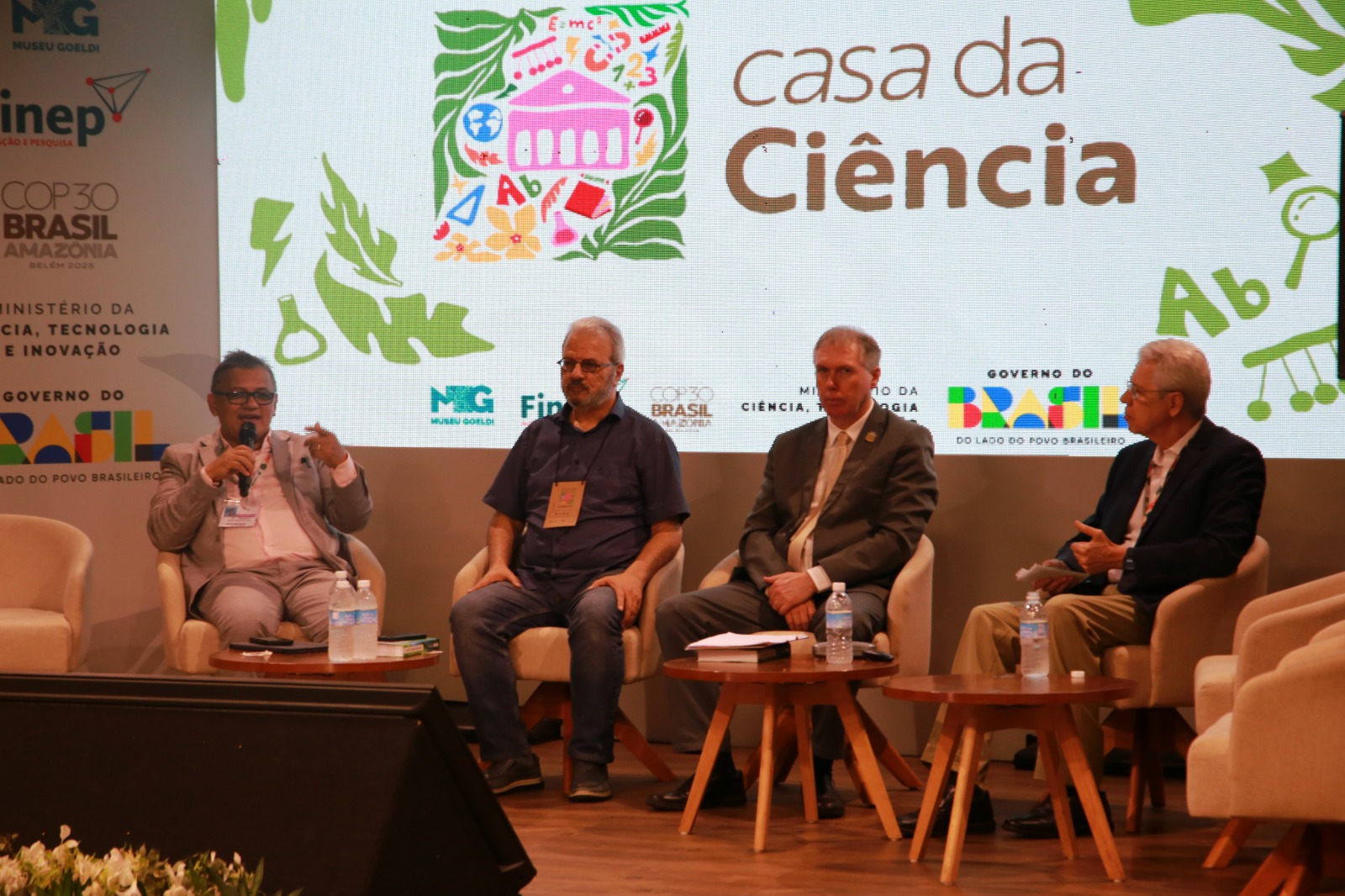
Klewerson Lima / Unifesspa
The debate demonstrated how sustainable policies and the knowledge produced by universities respond to social and climate challenges.
On the last day of the MCTI Science House, in Belém (PA), this Friday (21), experts debated how to increase resilience and technological advances in the Amazon. The panel brought together rectors of research institutions in the region and the Center for Management and Strategic Studies (CGEE), a social organization of the MCTI. The Science House is the space of the Ministry of Science, Technology and Innovation (MCTI) during the United Nations Climate Change Conference (COP30).
The panel demonstrated that universities and research institutes are the spaces where knowledge is transformed into value for society in many different areas. The rector of the Federal University of Southern and Southeastern Pará (Unifesspa), Francisco Ribeiro da Costa, spoke about the presence of research institutions in the Legal Amazon.
There are 14 federal universities present in 78 campuses, in 170 municipalities. According to him, these institutions are necessary to produce solutions to conflicts such as deforestation and land disputes. "The answer lies in strengthening public universities in the Amazon and the university as a scientific agent capable of producing technologies, training local professionals, and articulating traditional knowledge and innovation," he pointed out.
The rector of the Federal University of Northern Tocantins (UFNT), Airton Sieben, stated that the production of knowledge and the preservation of standing forests are important for solving challenges worldwide in the social, environmental, energy, and health areas.
"It is in the Amazon that we have alternatives to face the great problems of humanity. In traditional communities, we have the conditions to mitigate the problems that involve the environment in general," he emphasized.
The director of the Center for Management and Strategic Studies (CGEE), Fernando Rizzo, emphasized the urgency of integrating science, politics, and society. Among the measures that have been making a difference, he listed systems for monitoring deforestation and degradation of biomes and for predicting natural disasters.
"Today, the ease of data sharing allows for interoperability and is very opportune for the Amazon region to benefit from. CGEE has been very involved in this. These are paths to the future: thinking about water as the axis of climate security, climate education, and the OneHealth approach, in which caring for the planet is caring for human health."
Source: Ascom MCTI
Related news
CGEE supports international climate debate with contributions towards the implementation of the BTIP.
23 of April, 2026The relevance of these contributions was highlighted by Secretary Pedro Ivo Ferraz da Silva, coordinator of Scientific and Technological Affairs at the Climate Department of the Ministry of Foreign Affairs, and the first Brazilian president of the UNFCCC's Executive Committee on Technology (TEC).
CGEE drives the Green Industrial Transition with a focus on financing and bioindustry.
26 of November, 2025TVI project combines science, innovation and funding to strengthen the sustainable bioeconomy.
Results from the 3rd ICID are presented at COP30 in panels at the House of Science.
26 of November, 2025ICID III reinforces debates on drylands and desertification at COP30.