The Dark Side of the Moon — and Ours
9 of April, 2026
Share:
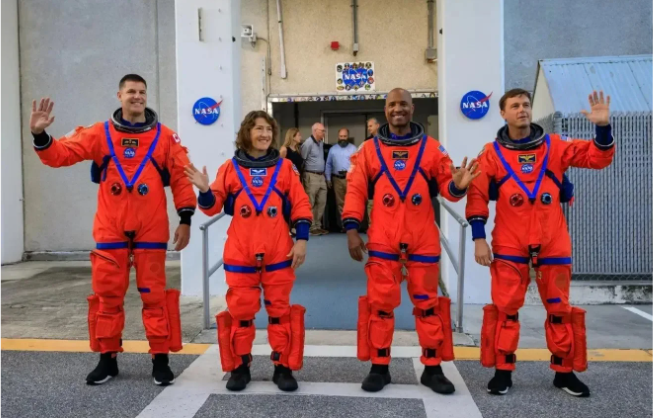
Exploring space has always been, to some extent, exploring ourselves. And perhaps true progress isn't just about going further.
Anderson SL Gomes
The Artemis II mission marks a new chapter in human exploration: returning to the moon not only as a technical achievement, but as a symbol of continuity, curiosity, ambition, and cooperation. By reaching regions never before explored with direct human presence, such as the so-called "far side" of the Moon, we expand not only our knowledge, but also our perception of our place in the universe.
Since 1969, when humans first set foot on the Moon, much has changed. Decades of unmanned missions followed, silent probes that mapped, measured, and observed from a distance. In 2023, one of these missions—still without a human presence—reached the far side of the moon, expanding frontiers in an unprecedented way. Now, with Artemis II, NASA is getting closer again, and humanity is once again looking directly at this previously inaccessible territory, transforming what was invisible into concrete experience.
But the value of these missions goes beyond symbolic achievement. Space exploration has always generated profound impacts on Earth. Technologies developed to survive the extreme environment of space end up being incorporated into everyday life: advances in communication, stronger and lighter materials, navigation systems, climate monitoring, medicine, and even solutions to resource scarcity. More than that, these missions mobilize knowledge, train generations of scientists and engineers, and stimulate international cooperation at a level rarely seen in other fields.
There is also a less tangible, but equally important value: the ability to inspire. Looking at the Moon—and now at its far side—reminds us that there are boundaries that only exist until someone decides to cross them. Space exploration expands the human imagination, shifts our limits, and invites us to think about the future, about possibilities, about something bigger than immediate problems.
But that's precisely where an inevitable contrast arises. While we design technology capable of traversing the void of space and reaching distant worlds, here on Earth we continue to face old conflicts—wars, inequalities, power struggles. It's as if we are able to illuminate the unknown out there, but still have difficulty dealing with the shadows within ourselves.
Perhaps the greatest lesson of the Artemis II mission lies not only in the space conquest, but in the provocation it brings us. If we managed to cooperate to leave the planet, why do we still fail to cooperate fully within it? If we managed to unveil the hidden side of the Moon, what still prevents us from facing—and transforming—the hidden sides of humanity itself?
Exploring space has always been, to some extent, exploring ourselves. And perhaps the real breakthrough isn't just about going further, but using that movement to mature right here, close to home, where it all begins.
Anderson SL Gomes, president of the Pernambuco Academy of Sciences, vice-president for the Northeast-Espírito Santo region of the ABC, professor at UFPE, and CEO of CGEE.
Article originally published by Jornal do Commercio: https://digital.jc.uol.com.br/edicao?ed=2646&materia=114130
Related news
To avoid becoming dependent on GPS.
13 of October, 2026In an article published in O Globo, the CEO of CGEE, Anderson Gomes, articulates the importance of mastering the Positioning, Navigation and Time (PNT) system, which enables telecommunications services, financial systems, precision agriculture, air transport, logistics and energy.
Brazil and critical minerals after the new framework.
5 of October, 2026Only regulation will determine whether a country will transform mineral wealth into technology and sovereignty.
Rare professionals: industrialization alone is not enough; the country needs workers who can transform minerals into technology.
14 of September, 2026In an article published in CartaCapital, the CEO of the Center for Management and Strategic Studies (CGEE), Anderson Gomes, discusses one of the bottlenecks for Brazil's progress in this area: the training of specialized human resources.