Project integrates public higher education institutions and the productive sector through innovation.
5 of May, 2026
Share:
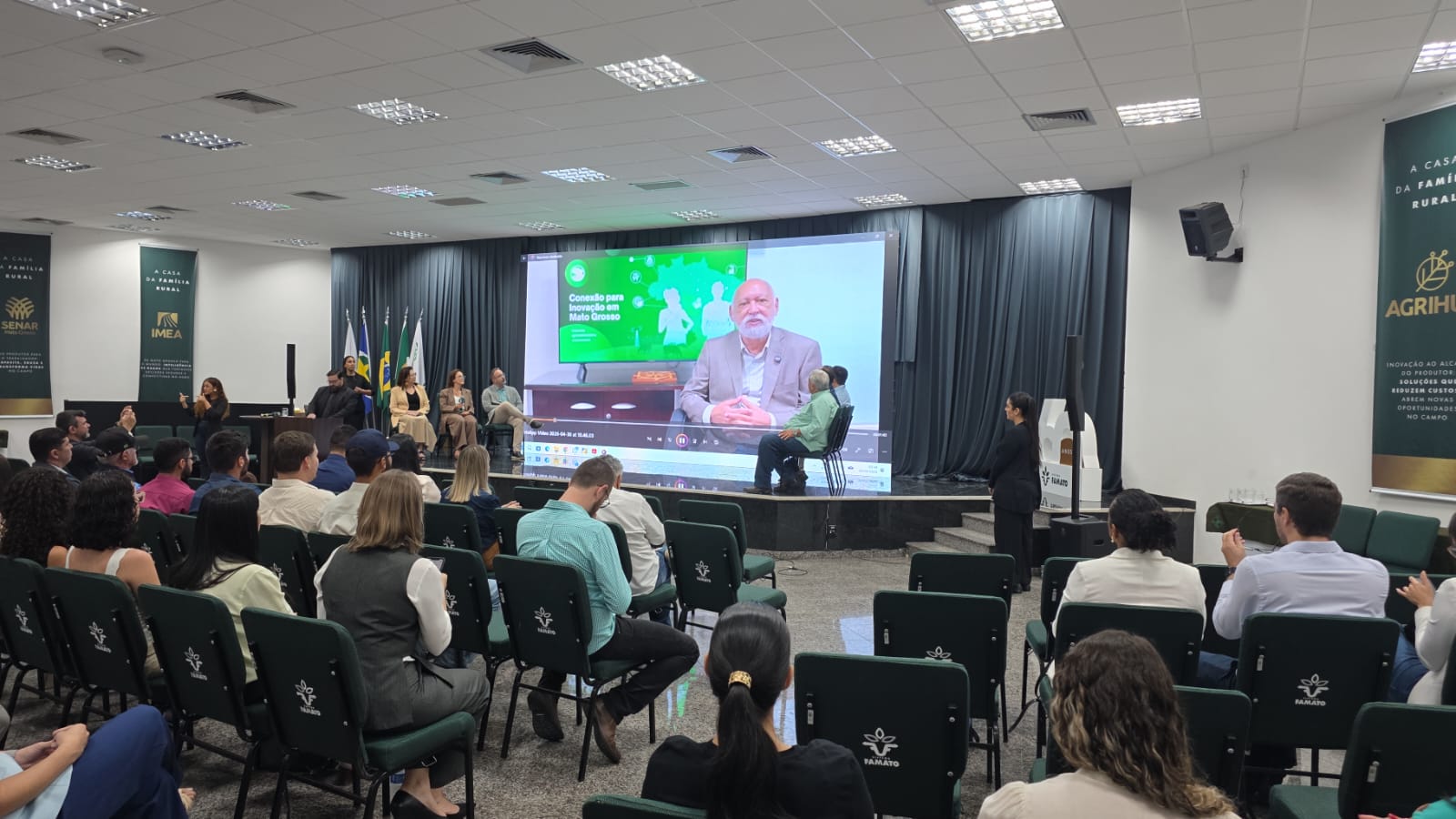
The initiative promotes collaboration between academia and production to boost sustainable rural development.
The event Connection for Innovation in Mato Grosso: Sustainable Agri-food Systems was held yesterday (04) in Cuiabá (MT), bringing together public higher education institutions and representatives of the productive sector with the aim of boosting rural development through innovation and entrepreneurship.
Coordinated by the Federal Institute of Mato Grosso (IFMT) and carried out in partnership with the Federal University of Mato Grosso (UFMT), the Federal University of Rondonópolis (UFR), and the State University of Mato Grosso (Unemat), the initiative had the support of the Center for Management and Strategic Studies (CGEE) – a social organization linked to the Ministry of Science, Technology and Innovation (MCTI) – and was made possible through a parliamentary amendment by Senator Wellington Fagundes.
The project aims to strengthen the connection between science and production, bringing technology and innovation, especially to small and medium-sized producers, increasing productivity, improving logistics and boosting local income, with a focus on sustainability and valuing family farming.
During the event, Senator Wellington Fagundes highlighted the importance of transforming scientific knowledge into practical solutions for the population. “I want to express my enthusiasm at being here. When this project was presented to me, I thought about how important it would be and also about its continuity. That's why I want, above all, to commit myself, because this September we will be preparing the budget for next year. Today, here, the panel defined the projects with great responsibility, because these projects will have future applications for our population. We have been trying to transform a culture in Brazil, which is to create projects and then leave them on the shelf. That's why we are changing that and allocating resources so that projects like these can be put into practice to change the reality of life for many people in Mato Grosso,” he stated.
The director of CGEE, Anderson Gomes, emphasized that innovation only fulfills its role when it transforms the reality of society. According to him, the project strengthens cooperation between institutions and values local knowledge. "Our goal is to use science and technology to solve real problems, with measurable social impact," he pointed out.
During the event, eight projects were presented by teams from participating institutions and evaluated by a panel of six judges. The winning proposal was Project 8 – Encapsulated leaf extract of Apeiba tibourbou for the control of Spodoptera frugiperda, coordinated by Professor Juliana Gallet, from Unemat, Alta Floresta, with the participation of students. The initiative proposes a sustainable method for controlling defoliating caterpillars in agricultural and forestry crops.
“I would like to highlight the important partnership of Senator Wellington Fagundes and his commitment to science and technology in Mato Grosso, always sending amendments to our institutions. This has guaranteed our work, and this event is yet another example of this support and vision, that we need to increasingly invest in science and technology as a tool for transforming lives,” stated Gilcélio Pérez, Vice-Rector of IFMT.
The rector of UFMT, Marluce Souza Silva, also highlighted the challenges faced by the institutions and the relevance of the initiative. “This event is very important because conducting research in our country has not been easy. In fact, teaching and outreach have not been easy either. We are involved in many difficulties, but even so, we found a participatory audience, with important individuals who build the history, research, science, and development of our state.”
( With information from the office of Senator Wellington Fagundes).
Related news
Presidente do CGEE debate estratégias para fortalecer a capacidade nacional de resposta a emergências biológicas no Rio Innovation Week
4 of August, 2026Painel reunirá especialistas para discutir como ciência, tecnologia e inovação podem fortalecer a biossegurança, a bioproteção e a soberania tecnológica do país.
The initial milestone of the Innovation Diplomacy Project defines five strategic areas of action.
2 of June, 2026An initiative led by CGEE and MRE will produce evidence, indicators, and diagnoses to support Brazil's international performance in priority technological areas.
MCTI launches working group to transform mineral wealth into technology, industry, and sustainable development.
14 of May, 2026New MCTI group will propose actions to expand technological and industrial content in Brazilian mineral supply chains.