CGEE participates in debates in the High-Level Segment of COP30
19 of November, 2025
Share:
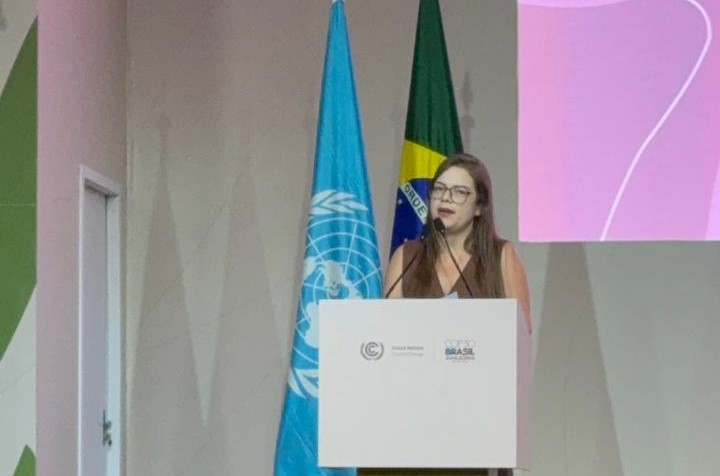
Intervention in the HLS highlights the contribution of research organizations to more effective climate decisions aligned with the Paris Agreement.
Emilly Caroline, technical advisor for the Positive Agenda for Climate Change project at the Center for Management and Strategic Studies (CGEE), participated this Tuesday (November 19) in the High-Level Segment (HLS) of COP30, the space where heads of delegation, international authorities and observer groups present their official positions on climate negotiations.
The HLS marks the most political phase of the conference, bringing together representatives from countries and organizations to guide decisions that should be consolidated by the end of the week. The opening, this Monday, took place in the Amazonas Plenary and was attended by the Vice President of Brazil, Geraldo Alckmin, the President of the United Nations General Assembly, Annalena Baerbock, the President of COP30, André Corrêa do Lago, and the Executive Secretary of the UNFCCC, Simon Stiell.
Representing the RINGO group (Research and Independent NGOs), Emilly Caroline spoke alongside national delegations and multilateral institutions, reinforcing the importance of science-based decisions and transparent processes.
In his speech, he highlighted the collaborative nature of the negotiations. “We commend the positive energy and universal commitment to multilateralism at this conference. The collaborative consultations have been constructive and focused. We encourage the Presidency and the Parties to continue in this spirit and look forward to robust decisions by the end of the week,” he stated.
The CGEE representative also highlighted the centrality of science in climate policies. “Solutions must be based on credible and rigorously evaluated scientific knowledge to guide effective decision-making. This applies to all the issues considered here in Belém. Science and research are essential for robust NDCs aligned with the 1.5°C target, for the development of innovative sources of climate finance, for the integrity of the carbon market, for mitigation and adaptation programs, and for generating data to support the Paris Agreement reports.”
Emilly also expressed concern about the reduction in investments in Earth observation. “We appreciate Earth Information Day and the comprehensive updates from a wide range of organizations, but we share the concern about the reported decline in support for Earth observations.”
The researcher further emphasized the importance of improving the procedures for the Global Stocktake. "We encourage the CMA to complete the work on improving the procedures for the global stocktake, as they have significant implications for how the research community can best contribute to the second GST."
Finally, he left a message on behalf of the research group. “Our community represents experts in agriculture, Article 6, the cryosphere, finance, loss and damage, health, oceans, and technology. We offer our support as a community of knowledge and action for the achievement of climate goals,” he concluded.
Related news
CGEE supports international climate debate with contributions towards the implementation of the BTIP.
23 of April, 2026The relevance of these contributions was highlighted by Secretary Pedro Ivo Ferraz da Silva, coordinator of Scientific and Technological Affairs at the Climate Department of the Ministry of Foreign Affairs, and the first Brazilian president of the UNFCCC's Executive Committee on Technology (TEC).
CGEE drives the Green Industrial Transition with a focus on financing and bioindustry.
26 of November, 2025TVI project combines science, innovation and funding to strengthen the sustainable bioeconomy.
Results from the 3rd ICID are presented at COP30 in panels at the House of Science.
26 of November, 2025ICID III reinforces debates on drylands and desertification at COP30.